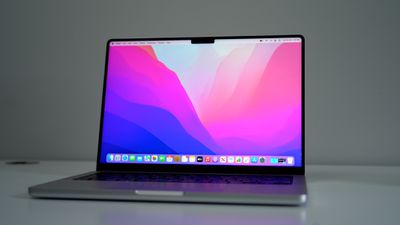
Apple in October 2021 introduced its second-generation Apple silicon chips, the M1 Pro and the M1 Max, which follow the M1 and are available in the 14 and 16-inch MacBook Pro models.
This guide focuses on the M1 Pro chip. The M1 Pro is an improvement the M1, but it is not quite as powerful as the M1 Max.
M1 Pro Explained
The M1 Pro is Apple's second System on a Chip (SoC) developed for use in Macs, and it marks Apple's continued transition away from the Intel chips that have been used in Macs since 2006.
As a "System on a Chip," the M1 Pro integrates several different components, including the CPU, GPU, unified memory architecture (RAM), Neural Engine, Secure Enclave, SSD controller, image signal processor, encode/decode engines, Thunderbolt controller with USB 4 support, and more, all of which power the different features in the Mac.
Traditional Intel-based Macs used multiple chips for the CPU, GPU, I/O, and security, but integrating multiple components onto one chip allows Apple silicon chips to operate faster and more efficiently than Intel chips. Like the M1, the M1 Pro is built on a 5-nanometer process, but it has 33.7 billion transistors, twice as many transistors as the M1.
CPU
The M1 Pro officially has 10 CPU cores, including two efficiency cores and eight high performance cores, but there is a low-end variant that has just 8 cores that's used in the base-level MacBook Pro. The 8-core CPU has six high performance cores and two high efficiency cores.
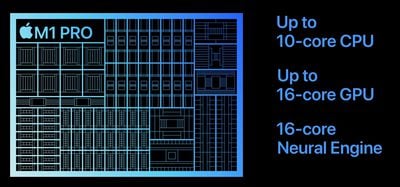
M1 Pro chips used in all other 14 and 16-inch MacBook Pro models have 10 cores. According to Apple, the M1 Pro's 10-core CPU is up to 70 percent faster than the 8-core CPU in the original M1 chip.
Compared to the latest 8-core PC laptop chip from Intel, the M1 Pro offers 1.7x more CPU performance at the same power level and it reaches the PC's performance using 70 percent less power.
GPU
The 10-core M1 Pro is equipped with a 16-core GPU, and the 8-core M1 Pro has a 14-core GPU. The 16-GPU variant is up to 2x faster than the M1 chip.
Memory
Apple is using a unified memory architecture that lets the CPU, GPU, and other processor components use the same data pool rather than wasting time copying data between one another and swapping between multiple pools of memory. It's a technique that makes all of Apple's M-series chips remarkably efficient.
With the M1, available memory maxed out at 16GB, but the M1 Pro supports up to 32GB. It also offers up to 200GB/s of memory bandwidth.
Media Engine
Apple added a Media Engine to the M1 Pro for accelerating video processing. There's also dedicated acceleration for the ProRes video codec.
Other Chip Features
The M1 Pro has several other built-in technologies.
- 16-core Neural Engine for machine learning.
- A display engine that drives external displays.
- Integrated Thunderbolt 4 controllers that offer more I/O bandwidth than before.
- A custom image signal processor used to enhance the camera's image quality.
- Secure Enclave with hardware-verified secure boot and runtime anti-exploitation technology.
M1 Pro vs. M1 Max
The M1 Pro and the M1 Max share the same 10-core CPU (with the exception of the base 8-core Pro chip), but have different graphics capabilities.
The M1 Pro has up to a 16-core GPU, while the M1 Max has up to a 32-core GPU.