

Apple's smartphones have been released on a "tick-tock" cycle since 2008. The iPhone 6 lineup represented a "tick" year, which involved a complete design overhaul, while the iPhone 6s lineup was part of a "tock" year, which generally focused on camera and processor improvements, new features such as 3D Touch and Live Photos, and incremental refinements like faster Touch ID, LTE, and Wi-Fi.
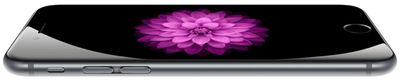
From a distance, the iPhone 6 and iPhone 6s lineups look and feel like virtually identical smartphones. It is true that both models share several attributes, but the iPhone 6s and iPhone 6s Plus have many features that are not included on the year-older iPhone 6 and iPhone 6 Plus. So, which one should you choose to purchase or upgrade to? What about the rumored iPhone SE and iPhone 7? Let's take a closer look.
Shared Features Between iPhone 6s and iPhone 6
Design
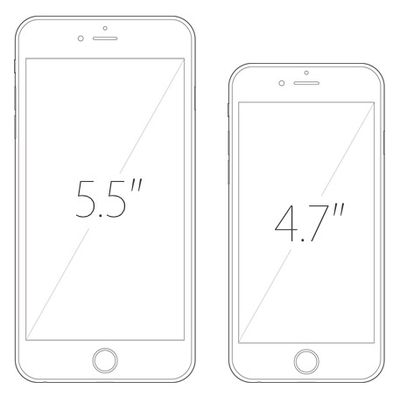
Apple fulfilled consumer demand for larger-screen smartphones with the 4.7-inch iPhone 6 and 5.5-inch iPhone 6 Plus, and it retained those sizes for the iPhone 6s and iPhone 6s Plus. If you prefer another screen size, the so-called 4-inch "iPhone SE" is expected to be announced at Apple's rumored March media event. All older iPhones released in 2013 or earlier also measure between 3.5" and 4" diagonally.
Virtually all other design aspects of the larger iPhones are the same, including a unibody aluminum shell, 2.5D curved glass, round edges, pill-shaped volume buttons, circular speaker grilles, and more. Apple has always stuck with nearly identical designs for iPhone "S" models, including the iPhone 3G and iPhone 3GS in 2008-09, iPhone 4 and iPhone 4s in 2010-11, and iPhone 5 and iPhone 5s in 2012-13.
iOS 9
 iOS 9 is focused on intelligence and proactivity, enabling iOS devices to learn user habits and act on that information through app suggestions, notifications, and a customized "Siri Suggestions" interface populated with the user's favorite contacts and apps, nearby places, and relevant news stories.
iOS 9 includes several new features and improvements beyond Proactive Siri and Search, including Apple News, Apple Maps transit routing, Notes checklists and sketches, app thinning, a simpler HomeKit setup process, under-the-hood battery life enhancements, built-in two-factor authentication, and more.
Battery Life
The iPhone 6s has a 1715 mAh battery, which is smaller in capacity than the 1810 mAh battery that was in the iPhone 6. The iPhone 6s Plus has a 2750 mAh battery, also smaller in capacity than the 2915 mAh battery that was used in the iPhone 6 Plus.
Apple may have used a smaller battery to make room for vital 3D Touch components in the new iPhones, both of which include a new part called a "Taptic Engine." The Taptic Engine provides haptic feedback for 3D Touch gestures and also powers the vibrations for alarms and notifications.
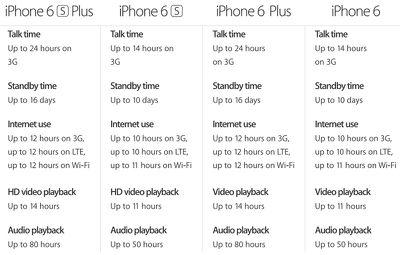
Nevertheless, efficiency improvements introduced with the A9 chip and other performance enhancements have resulted in the two devices offering the same battery life as the iPhone 6 and 6 Plus.
On paper, the iPhone 6s offers up to 14 hours of talk time, 10 days of standby time, 11 hours of video playback, 10 hours of Internet use on LTE. The iPhone 6s Plus offers 24 hours of talk time, 16 days of standby time, 14 hours of video playback, and 12 hours of Internet use on LTE.
New Features Found Only in the iPhone 6s and 6s Plus
Faster A9 Chip with 2GB of RAM
iPhone 6s and iPhone 6s Plus have a 64-bit Apple A9 chip with 2GB of RAM for up to 70% faster CPU performance and up to 90% faster graphics compared to the 64-bit A8 chip with 1GB of RAM in iPhone 6 and iPhone 6 Plus. The upgrades result in apps opening slightly quicker and overall improved speed across iOS, apps, and games.
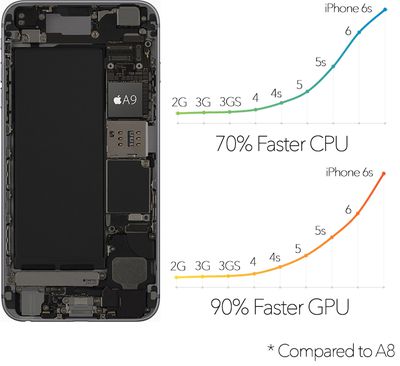
Apple has also directly embedded the M9 motion coprocessor into the A9 chip for increased performance and efficiency. Both the iPhone 6's M8 and iPhone 6s's M9 connect to the accelerometer, compass, gyroscope, and barometer for fitness tracking, but only the M9 is efficient enough to detect audio input in the background for always-on "Hey Siri" functionality on iOS 9 or later.
Improved Cameras with 4K Video
iPhone 6s and iPhone 6s Plus have an upgraded 12-megapixel rear-facing iSight camera and 5-megapixel front-facing FaceTime camera, compared to an 8-megapixel iSight camera and 1.2-megapixel FaceTime camera on iPhone 6 and iPhone 6 Plus. Coupled with the A9 chip, this translates to faster auto focus, and improved color accuracy, details, and sharpness, particularly in low light.
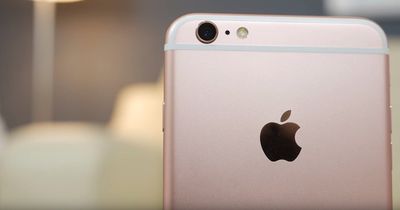
The FaceTime camera's jump to a 5-megapixel sensor is especially noticeable, resulting in significantly reduced noise for "selfies" and other photos. The front-facing shooter still lacks LED flash, but Apple introduced a new feature called "Retina Flash" that flashes the display when you take a photo. The feature is based on a custom chip that makes the display flash up to three times brighter than usual.
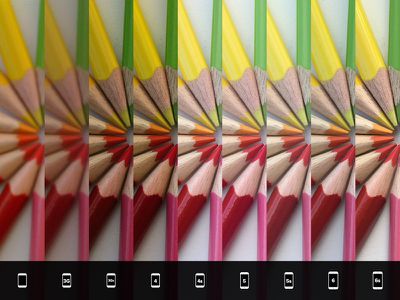
iPhone 6s and iPhone 6s Plus can also capture 4K video at 30FPS, allowing iPhone users to take videos with incredible levels of detail. 4K video joins 240FPS Slo-mo video and Time-Lapse video, both features introduced in past-generation devices. Time-Lapse video gains new stabilization features with the new iPhones.
Apple also says the iPhone 6s and iPhone 6s Plus cameras have improved local tone mapping, improved noise reduction, panoramas up to 63 megapixels, playback zoom, and the ability to shoot 8-megapixel still photos while recording 4K video. iPhone 6s Plus also exclusively has image stabilization for video.
Live Photos
Live Photos is a new feature exclusive to the iPhone 6s and iPhone 6s Plus. When enabled, the feature captures an extra 1.5 seconds before and after a shot, with the footage being used to animate the photo with movement and sound. The result looks something like a short GIF.
 If you are planning on purchasing a new iPhone, consider holding off for about six months if possible. Apple's much-rumored




































Top Rated Comments
The 4s and 5s iPhones remain the best iPhone releases so far, when judged against timing, context and predecessor.
They both saw a bigger percentage leap in CPU and GPU than any other iPhone release.
They also fixed design 'flaws/quirks' as well as introducing supremely good new features (Siri/Touch ID).
The 6s has been somewhat poorer received, reflecting some antipathy towards the fairly agreed 6-series design mistakes (camera lens protrusion, antenna lines, poor ergonomic handling because of curved phone edges, etc etc) and very little in the way of innovation, especially at a time when competitors phones really are innovating, and arguably jumping ahead of Apple. 3D Touch is not a game-changing feature, no matter how much you wish it were.
The arguments of thinness vs. battery life will continue, despite us knowing where Apple have laid their vision.
The camera is clearly an area of interest for Apple, and I think innovations or developments in the camera will be a big part of future iPhone releases.
- But what really has become clear is that one size does not fit all. There are strong opinions about device size/screen size across the customer base, much like there would be about any consumer IT product. And features that some love, others have no use for. The absolute must for Apple is to recognise this, and balance their product design accordingly.
Oh, and bump the starting memory from 16 to 32GB. This is 2016 ffs.
Having said that the S year is always interesting because the physical form does not change but so much else does. For example, in the 6S the faster Touch ID and the better camera were significant for me. The 3D touch thing and the live picture thing - dont really care for them yet. The number years are always fun because of the physical changes to the phone. Obviously there is a lot more going on each year, but it is my impression that number years seem to focus on the physical and the S year seem to focus on the feature. As far as performance goes, every year is a performance increase.
”To be perfectly honest, this past year has been remarkably boring in the mobile segment. For whatever reason, phones have either stood still or regressed when it comes to overall quality. There are a few stand-outs that have been worth talking about like the Galaxy S6 lineup and the Galaxy Note5 lineup, but for the most part every phone I’ve reviewed this year has been disappointing in some way. I carry an iPhone 6 to make sure I stay current on changes in iOS, but my primary phone continues to be an HTC One M7. I was hoping to get a new Android phone this year, but so far nothing has really piqued my interest.”
http://www.anandtech.com/show/9686/the-apple-iphone-6s-and-iphone-6s-plus-review
They gave the iPhone 6s ”Editors' Choice - Gold” by the way.
Did you really think it was that bad? Compared to what, the 5s? To me felt fast, but I also compared to the 4s I moved up from…
I went from 6 to 6s. I didn't like the 6 -- performance felt like a regression for a model that was just released. I think 1GB of RAM was holding it back. I was using Touch ID for the first time (had a 4s before that) and it was slow enough to be annoying. I was getting used to the size change which took significant adjustment until I was comfortable, so that contributed to my dislike.
The 6s is a significantly better phone. Performance is great, Touch ID is nearly instantaneous, 3D Touch is very useful to me (YMMV), the camera is fantastic, cellular reception is better. And I guess I've learned the contortions necessary to use it one handed well enough that it's not too annoying anymore, though the weight increase from 6 -> 6s was noticeable and I like the lighter weight better (that's the only thing I can complain about with the 6s).
Despite my disappointment with the 6, I'm probably going to upgrade every year from now on. I used to hold on to my phones as long as I could stand to, but that just isn't worth it for me. For me, it's worth spending the money to have the fastest possible device. With the iPhone Upgrade Program, it's very convenient and trade-in costs difference vs selling it yourself are negligible (you're paying a little more to have no hassles), and you're not locked to a specific carrier which is nice.
By comparison the "s" cycle has never felt the same sluggishness after only 2 years.
Personally I feel that the "s" cycle has been more reliable build, with fewer issues. But I'm still a sucker for a new design.