Apple Turns 50 Today: Reflecting on Each Decade's Biggest Moments - MacRumorsOpen MenuShow RoundupsShow Forums menuVisit ForumsOpen Sidebar
Skip to Content

Apple Turns 50 Today: Reflecting on Each Decade's Biggest Moments

Apple was founded on April 1, 1976, meaning the company is officially 50 years old as of today. To honor the occasion, we have reflected on some of Apple's biggest moments of each decade, from the 1970s through to the 2020s.
Apple 50 Logo Feature
Apple has an extensive history, so this list is far from comprehensive, but it captures some of the pivotal events over the company's first 50 years.

1970s

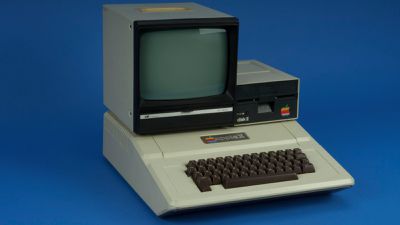
While the Apple-1 was released in 1976, it was the Apple II in 1977 that became the company's first successful, mass-market computer.
Apple II Original
Unlike the Apple-1, the Apple II came fully assembled in a plastic case with a keyboard, and Apple sold millions of units of the computer over the years. This product gave Apple sustained cash flow, allowing it to become a major company.

1980s

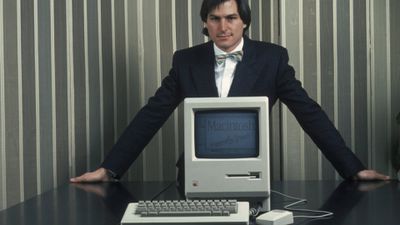
In 1984, Steve Jobs introduced the Macintosh, the world's first successful mass-marketed computer with a graphical user interface (GUI).

The original Macintosh popularized the computer mouse, allowing users to control an on-screen pointer. This point-and-click method of computer navigation was still a novel concept to most people at the time, as personal computers in this era typically had text-based command-line interfaces controlled with a keyboard.
Steve Jobs Macintosh PR Handout
Apple said the Macintosh typically took "only a few hours to learn," and it touted what are now basic computer features, such as a desktop with icons, the ability to use multiple programs in windows, drop-down menus, and copy and paste.

Pricing for the original Macintosh started at $2,495, equivalent to nearly $8,000 today. Key specs and features included an 8 MHz processor, 128 KB of RAM, a 400 KB floppy disk drive for storage, and serial ports for connecting a printer and other accessories.

In 1985, Apple released the LaserWriter, one of the first mass-market laser printers.

1990s

By the 1990s, Apple had largely lost its way. That changed when Jobs returned to the company in 1997, as part of Apple's acquisition of NeXT, another computer company founded by Jobs after he was ousted from Apple in the mid-1980s.
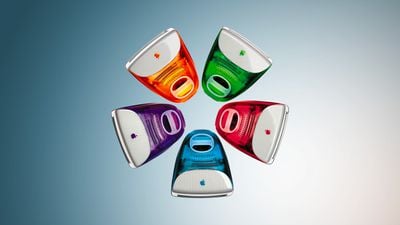
iMac G3 Fanned Feature
Apple did release some unique products in the 1990s, ranging from the Newton personal assistant to the QuickTake digital camera to the Pippin video game console, but Jobs' return was easily the company's pinnacle moment of the decade. He quickly simplified and improved Apple's product lineup, with the turnaround beginning in earnest with the colorful iMac in 1998.

Apple's acquisition of NeXT also gave it NeXTSTEP, the UNIX-based operating system that ultimately became Mac OS X, the successor to classic Mac OS.

2000s

Apple's renaissance continued into the 2000s with the launch of the iPod in 2001. The portable music player was extremely popular and helped turn Apple into a consumer electronics company rather than merely a computer company.
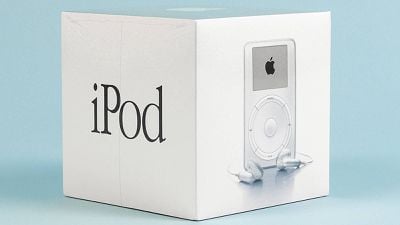
iPod 2001 Box
Six years later, Apple combined an iPod with a mobile phone. Enter the iPhone.

Jobs famously introduced the original iPhone as if it were three separate products: a widescreen iPod with touch controls, a revolutionary mobile phone, and a breakthrough internet communications device. The crowd at Macworld San Francisco erupted with cheerful applause upon realizing that Jobs was referring to a single device.
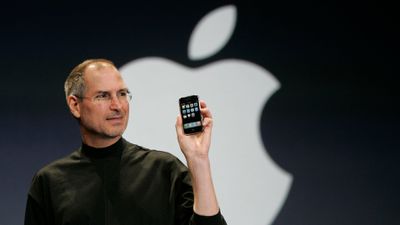
Steve Jobs iPhone 2007 PR Handout
While the iPod was hugely successful, the iPhone is absolutely massive, and it is now one of the most successful products of any kind ever released. Last year, Apple announced that it had shipped its three billionth iPhone. That is 3,000,000,000.

2010s

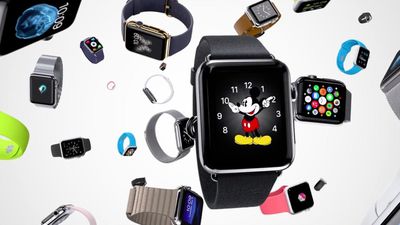
Three major Apple products launched throughout the 2010s, including the iPad in 2010, the Apple Watch in 2015, and the AirPods in 2016.
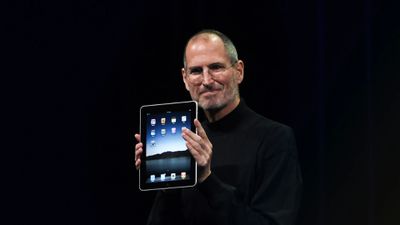
Steve Jobs iPad 2010
While the iPad was essentially just a large-screened iPhone when it first launched, the device has received significant advancements like trackpad support over the years, and it has since redefined what a personal computer is.

Millions of people wear an Apple Watch, and it has become one of the world's most popular fitness devices. With health and safety features like the ECG app, Crash Detection, Fall Detection, Emergency SOS, and more, the Apple Watch has even saved lives, which is a remarkable feat and something that Apple's CEO Tim Cook is very proud of.
2015 Apple Watch
As for AirPods, Apple says they are the world's most popular wireless headphones. Enough said.

2020s

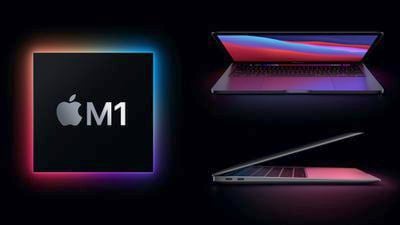
In 2020, the Mac's transition from Intel processors to Apple silicon began, resulting in industry-leading performance-per-watt to this day.
m1 chip macbook air pro
After years of rumors, Apple unveiled its plan to transition the entire Mac lineup from Intel processors to its own custom-designed chips at WWDC in June 2020. Later that year saw the release of the first three Mac models powered by Apple silicon, including a 13-inch MacBook Pro, MacBook Air, and Mac mini. The transition was completed in 2023 when the Mac Pro—which was recently discontinued—received the M2 Ultra chip.

Apple said macOS Tahoe is the final macOS release that will support Intel-based Macs.

In 2023, the Apple Vision Pro launched, ushering in the spatial computing era. A year later, the Apple Intelligence suite of AI features arrived. Unfortunately, these hardware and software categories have not entirely panned out yet.

Over the coming years, Apple is expected to push further into wearables, with products such as smart glasses, a pendant, and AirPods with cameras.

Top Rated Comments

12 hours ago at 12:44 am
This is a very concise history, but no mention of OS X, based on the NeXTStep OS that came with Jobs from NeXT..?

That was the most significant factor in the recovery of Mac -- and gave iPhone and all the other devices the functionality and connectivity that they have.
Score: 11 Votes (Like | Disagree)
9 hours ago at 04:22 am
Notable omissions, two of which didn't involve Steve Jobs:

* The Apple Laserwriter ('https://en.wikipedia.org/wiki/LaserWriter') and Appletalk/Localtalk ('https://en.wikipedia.org/wiki/LocalTalk') - 1985 - popularised the laser printer, popularised "desktop publishing" and popularised local area networking: Localtalk was a plug-and-play, no tech skills needed networking system that allowed a bunch of Macs to share a single (& still eye-wateringly expensive) Laserwriter.
* Powerbook 100/140/170 ('https://en.wikipedia.org/wiki/PowerBook') - 1991 - These weren't the first "laptops" but the design featured a full-depth clamshell & large screen, set-back keyboard and central pointing device (intitially a trackball, but touchpads followed) which was subsequently copied by the entire laptop industry and is still the basis of most modern laptops.
* Advanced RISC Machines Limited ('https://en.wikipedia.org/wiki/Arm_Holdings')- 1990 - The ARM processor had already been developed by Acorn ~1986, but ARM Ltd was created as a joint venture between Acorn, Apple and VLSI to develop the chip for the Newton. Yup, the Newton may merit mention as a Heroic Failure but it was also part of the history of ARM - and, hence, almost every smartphone in existence plus Apple Silicon...
Score: 8 Votes (Like | Disagree)
13 hours ago at 12:20 am
Happy 50!
Score: 8 Votes (Like | Disagree)
13 hours ago at 12:20 am
Apple is simply just two fold: Apple with Steve and Apple without Steve.

It is a perfect reflection of what it means to have a maniacally driven innovator as a leader and what it means to not have that person at the helm.
Score: 7 Votes (Like | Disagree)
Joe Rossignol Avatar
8 hours ago at 05:18 am

This is a very concise history, but no mention of OS X, based on the NeXTStep OS that came with Jobs from NeXT..?

That was the most significant factor in the recovery of Mac -- and gave iPhone and all the other devices the functionality and connectivity that they have.
Added in NeXTSTEP for you.


To the Macrumors staff: It's a bit bizarre how every picture portraits the first iteration of every product but the Apple II, where you present a late model with a graphical interface and then, in the next section, you speak about how the Macintosh was the first GUI driven computer. It would be better to show the very first Apple II.
Updated the Apple II photo to an older model.


No mention of the iPod touch in the 2000‘s???
That was THE entry level device family that made young people use iOS. No one had an iPhone back then, but everybody’s kid had an iPod it felt like. I know that how I and many of my friends began.
I get it. iPod touch was my first Apple product. Christmas 2007.

Nevertheless, the iPod touch is an iPod, so it is already covered in this basic summary of Apple's history.


Notable omissions, two of which didn't involve Steve Jobs:

* The Apple Laserwriter ('https://en.wikipedia.org/wiki/LaserWriter') and Appletalk/Localtalk ('https://en.wikipedia.org/wiki/LocalTalk') - 1985 - popularised the laser printer, popularised "desktop publishing" and popularised local area networking: Localtalk was a plug-and-play, no tech skills needed networking system that allowed a bunch of Macs to share a single (& still eye-wateringly expensive) Laserwriter.
* Powerbook 100/140/170 ('https://en.wikipedia.org/wiki/PowerBook') - 1991 - These weren't the first "laptops" but the design featured a full-depth clamshell & large screen, set-back keyboard and central pointing device (intitially a trackball, but touchpads followed) which was subsequently copied by the entire laptop industry and is still the basis of most modern laptops.
* Advanced RISC Machines Limited ('https://en.wikipedia.org/wiki/Arm_Holdings')- 1990 - The ARM processor had already been developed by Acorn ~1986, but ARM Ltd was created as a joint venture between Acorn, Apple and VLSI to develop the chip for the Newton. Yup, the Newton may merit mention as a Heroic Failure but it was also part of the history of ARM - and, hence, almost every smartphone in existence plus Apple Silicon...

Added in the LaserWriter.

As for the other stuff, the intro of this blog post says that it is not a comprehensive look at Apple's history. There are plenty of omissions. I just pick and chose some big things.
Score: 5 Votes (Like | Disagree)
HazeAndHahmahneez Avatar
11 hours ago at 01:33 am
HBD!!

RIP Steve (we love you so much)!!!

Thank you for all your hard work Woz, Ive, Tim etc.!!!

Thank you IBM, Microsoft, Google and Meta and etc (competition IS the way of the marketplace world, after all)!!!

Here’s to many more!!!
Score: 5 Votes (Like | Disagree)

🔗 Related Apple News & Rumors

Stay updated with the latest Apple ecosystem news and verified rumors