Apple M3 Pro Chip Has 25% Less Memory Bandwidth Than M1/M2 Pro

Apple's latest M3 Pro chip in the new 14-inch and 16-inch MacBook Pro has 25% less memory bandwidth than the M1 Pro and M2 Pro chips used in equivalent models from the two previous generations.
m3 pro chip
Based on the latest 3-nanometer technology and featuring all-new GPU architecture, the M3 series of chips is said to represent the fastest and most power-efficient evolution of Apple silicon thus far. For example, the 14-inch and 16-inch MacBook Pro with M3 Pro chip is up to 40% faster than the 16-inch model with M1 Pro, according to Apple.

However, looking at Apple's own hardware specifications, the M3 Pro system on a chip (SoC) features 150GB/s memory bandwidth, compared to 200GB/s on the earlier M1 Pro and M2 Pro. As for the M3 Max, Apple says it is capable of "up to 400GB/s." This wording is because the less pricey scaled-down M3 Max with 14-core CPU and 30-core GPU has only 300GB/s of memory bandwidth, whereas the equivalent scaled-down M2 Max with 12-core CPU and 30-core GPU featured 400GB/s bandwidth, just like its more powerful 12‑core CPU, 38‑core GPU version.

Notably, Apple has also changed the core ratios of the higher-tier M3 Pro chip compared to its direct predecessor. The M3 Pro with 12-core CPU has 6 performance cores (versus 8 performance cores on the 12-core M2 Pro) and 6 efficiency cores (versus 4 efficiency cores on the 12-core M2 Pro), while the GPU has 18 cores (versus 19 on the equivalent M2 Pro chip).

Additionally, while the M3 chip's 16-core Neural Engine has the same number of cores as the one Apple featured in the 3nm-based A17 Pro chip that debuted in the iPhone 15 Pro series in September, it's comparatively weaker on paper in terms of maximum achievable throughput, which is measured in trillions of operations per second (TOPS).

According to Apple, the M3 Neural Engine is capable of 18 TOPS, whereas the A17 Pro Neural Engine is capable of 35 TOPS. It's hard to say for certain, but it is possible that the iPhone 15 Pro requires a higher performing Neural Engine for features like computational photography and Face ID, whereas the M3 can compensate in other areas like machine learning by utilizing its additional GPU cores.

Taken together, it's presently unclear what real-world difference these changes make to M3 performance when pitted against Apple's equivalent precursor chips in various usage scenarios, especially given that the latest processors include new Dynamic Caching memory allocation technology which ensures that only the exact amount of memory needed is used for each task.
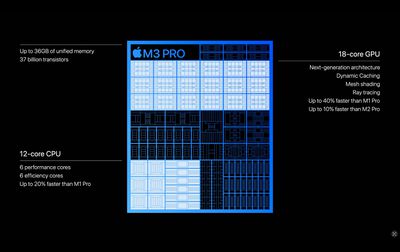
m3 pro soc
This opaqueness is not helped by the fact that Apple advertises the power of the new M3 Pro and M3 Max chips by repeatedly emphasizing comparisons to the M1 Pro and M1 Max, rather than the more recent M2 variants, against which performance gains appear more modest. Hopefully we will learn more in time when the first thoroughgoing third-party benchmarks become available.

The new MacBook Pro models are available to order now, and they will begin arriving to customers and launch in stores on Tuesday, November 7. Be sure to check out our MacBook Pro announcement coverage for all the details.

Related Roundup: MacBook Pro
Tag: M3
Buyer's Guide: MacBook Pro (Caution)
Related Forum: MacBook Pro

Popular Stories

Aston Martin CarPlay Ultra Screen

Apple's CarPlay Ultra to Expand to These Vehicle Brands Later This Year

Sunday February 1, 2026 10:08 am PST by
Last year, Apple launched CarPlay Ultra, the long-awaited next-generation version of its CarPlay software system for vehicles. Nearly nine months later, CarPlay Ultra is still limited to Aston Martin's latest luxury vehicles, but that should change fairly soon. In May 2025, Apple said many other vehicle brands planned to offer CarPlay Ultra, including Hyundai, Kia, and Genesis. In his Powe...
Apple Logo Black

Apple Just Made Its Second-Biggest Acquisition Ever After Beats

Thursday January 29, 2026 10:07 am PST by
Apple today confirmed to Reuters that it has acquired Q.ai, an Israeli startup that is working on artificial intelligence technology for audio. Apple paid close to $2 billion for Q.ai, according to sources cited by the Financial Times. That would make this Apple's second-biggest acquisition ever, after it paid $3 billion for the popular headphone and audio brand Beats in 2014. Q.ai has...
Apple Logo Black

Apple's Next Launch is 'Imminent'

Sunday February 1, 2026 12:31 pm PST by
The calendar has turned to February, and a new report indicates that Apple's next product launch is "imminent," in the form of new MacBook Pro models. "All signs point to an imminent launch of next-generation MacBook Pros that retain the current form factor but deliver faster chips," Bloomberg's Mark Gurman said on Sunday. "I'm told the new models — code-named J714 and J716 — are slated...
14 inch MacBook Pro Keyboard

Apple Changes How You Order a Mac

Saturday January 31, 2026 10:51 am PST by
Apple recently updated its online store with a new ordering process for Macs, including the MacBook Air, MacBook Pro, iMac, Mac mini, Mac Studio, and Mac Pro. There used to be a handful of standard configurations available for each Mac, but now you must configure a Mac entirely from scratch on a feature-by-feature basis. In other words, ordering a new Mac now works much like ordering an...
Apple MacBook Pro M4 hero

New MacBook Pros Reportedly Launching Alongside macOS 26.3

Sunday February 1, 2026 5:42 am PST by
Apple is planning to launch new MacBook Pro models with M5 Pro and M5 Max chips alongside macOS 26.3, according to Bloomberg's Mark Gurman. "Apple's faster MacBook Pros are planned for the macOS 26.3 release cycle," wrote Gurman, in his Power On newsletter today. "I'm told the new models — code-named J714 and J716 — are slated for the macOS 26.3 software cycle, which runs from...

Top Rated Comments

kiranmk2 Avatar
30 months ago
The mid-range models are too good, so they are nerfing them to push people to spend more on the top end models. Clearly done to boost the revenues in the short term in the face of declining sales (via increased revenue per device).

As I have said before (and will say again), this strategy does work well if you are popular and make good products, but eventually you will push people past the point where they are willing to spend more and sales/revenue will fall off a cliff.
Score: 68 Votes (Like | Disagree)
pappl Avatar
30 months ago
- Still 8GB base RAM
- IMHO Minor performace upgrades compared to other systems (not Intel base systems but nVidia systems)
- Still no AV1 Encoder ?‍♀️
- Reduced mem bandwith

Come on, where is the PRO?

nVidia was way ahead compared to M2, i don't see any change with M3.
This will not end well, and all the marketing ********ting (see event intros) make me angry.
Score: 49 Votes (Like | Disagree)
Jony Ive and Co. Avatar
30 months ago
This is outrageous. Apple should improve raw specs with every iteration, not go backwards in terms of memory bandwidth and Neural Engine. I'd expect the number of CPU cores to increase IN ADDITION to performance and efficiency gains for each individual core.

And it's also ridiculous whenever I see them not comparing with the direct predecessor (i.e. M2). They should squarely compare M3 against M2, and this goes for A17 Pro too when they compared it against A14 instead of A16. Same with comparing against "the most popular Windows PC" etc
Score: 48 Votes (Like | Disagree)
iMean Avatar
30 months ago
Hmm...so when the M8 arrives, there will be 40 efficiency cores and 0 performance cores ?
Score: 42 Votes (Like | Disagree)
widestload Avatar
30 months ago
Well they don't want to make it too good do they, otherwise where would then M4 have to go for its gains? (Sorry, I'm cynical :p)
Score: 35 Votes (Like | Disagree)
everlast3434 Avatar
30 months ago
I heard this is the best chip they’ve ever made!
Score: 35 Votes (Like | Disagree)