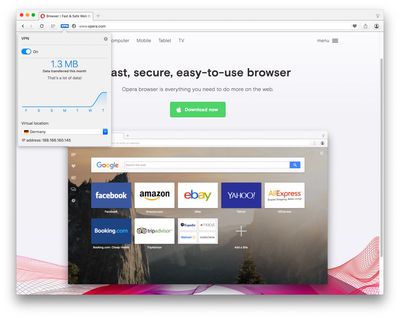
Norway-based company Opera Software has integrated a virtual private network (VPN) feature into the latest developer version of its free Opera web browser for OS X.
A VPN creates an encrypted tunnel from the user's computer to the VPN server, hiding browsing activity from other users on the local network and enhancing security and privacy online. A VPN shields a user's real IP address, allowing them to bypass firewalls, block tracking cookies, and access geo-restricted content regardless of their true location.
VPNs usually come in the form of separate plug-ins or apps that require a paid subscription, making Opera one the first major browsers to include one as standard. The launch of the feature comes after Opera's acquisition of U.S. VPN company SurfEasy last March.
Currently Opera's built-in VPN allows users to choose virtual locations in the US, Canada, and Germany. Opera says more countries will be available when the feature makes it to the stable public release of the browser.
Mac users can download Opera 38 developer release and give the free, unlimited VPN a try. After installation, simply click "Opera" in the menu bar, select "Preferences" and toggle the VPN switch on.
According to Global Web Index, more than half a billion people (24 percent of the world’s online population) have tried or are currently using VPN services. According to the research, the primary reasons people use a VPN are for better access to entertainment content, browser anonymity, and the ability to access sites restricted by their workplace or country.
In January, Netflix began blocking users who try to bypass country-based content restrictions by using a VPN. Canadian subscribers to the streaming service appear to have been the latest targets of the crackdown after VPN-tunnelled users in the country began seeing error messages on their screens over the weekend when trying to access the service's much larger U.S. catalogue of movies and TV series.
This should make it really convenient for the FBI/NSA to gather all your browsing data with just one request. Or perhaps they already have direct feed.
I'm pretty sure ISPs hand it over pretty easy already.
This should make it really convenient for the FBI/NSA to gather all your browsing data with just one request. Or perhaps they already have direct feed.
I'm not sure what a VPN has to do with anything above. You must think the above is not possible w/o a VPN. With or w/o a VPN web traffic is still flowing through an ISP. A VPN protects you a little better from amateur snoopers when you are using public wi-fi. That's all.
This should make it really convenient for the FBI/NSA to gather all your browsing data with just one request. Or perhaps they already have direct feed.
Apple uses a number of methods to keep HomeView users' personal information private, even when a whole household shares the device.
The device recognizes up to six people, giving each their own Home Screen with personalized apps and widgets. Apple says personal content stays private to each user, while shared photo albums and music can remain available to everyone in the household, including ...
Wednesday October 28, 2026 10:11 am PDT by Juli Clover
Apple today announced a new high-end MacBook Pro, which is available in 14-inch and 16-inch sizes. The new device has a PROLED XDR display that supports touch gestures, and a glowing rear Apple logo.
Pricing on the MacBook Pro starts at $2,899 for the 14-inch model and $3,399 for the 16-inch model.
Apple says the MacBook Pro has the "world's best display in a pro laptop." The PROLED...
Thursday October 29, 2026 1:47 pm PDT by Joe Rossignol
While the new iPad mini has an OLED display, the device does not support ProMotion, meaning the display's refresh rate is limited to 60Hz instead of 120Hz.
ProMotion support would have allowed for the iPad mini's refresh rate to automatically adjust from 10Hz to 120Hz depending on the content being displayed, but evidently Apple has kept the feature exclusive to the iPad Pro among iPad...



















































Top Rated Comments