M4 vs. M5 Chip Buyer's Guide: How Much Better Really Is M5?

Apple's newly introduced M5 chip takes Apple silicon to the next level, delivering meaningful gains across CPU, GPU, and AI workloads, but how does it compare to the M4?
M4 vs M5 Feature
Compared to the M4 chip that Apple launched in May 2024, the M5 delivers:

  • Up to 15% faster multithreaded CPU performance
  • Up to 30% faster overall graphics performance
  • Up to 45% faster ray tracing performance
  • 27.5% higher unified memory bandwidth

In addition to general performance claims, Apple published a set of specific real-world workload results showing measurable gains in AI-driven applications:

  • 4×+ peak GPU compute performance for AI
  • 3.6× faster time to first token (LLM)
  • 1.8× faster Topaz Video Enhance AI processing
  • 1.7× faster Blender ray-traced rendering
  • 2.9× faster AI speech enhancement in Premiere Pro

With the M5, Apple is heavily emphasizing an AI-centric design. The company says the new GPU architecture includes a dedicated Neural Accelerator within every GPU core, and that the chip delivers more than six times the peak GPU compute performance for AI compared to the M1. Apple also cites improvements to the Neural Engine, memory bandwidth, and developer-facing APIs to support on-device AI models. Other hardware changes compared to the M4 include:

M4 Chip M5 Chip
Made with TSMC's second-generation 3nm process (N3E) Made TSMC's third-generation ‌3nm‌ process (N3P)
Based on A18 Pro chip from iPhone 16 Pro Based on A19 Pro chip from iPhone 17 Pro
No integrated Neural Accelerators Integrated Neural Accelerator in every GPU core
Metal 3 developer APIs Metal 4 developer APIs with Tensor APIs to program GPU Neural Accelerators
Second-generation ray tracing engine Third-generation ray tracing engine
First-generation dynamic caching Second-generation dynamic caching
Shader cores Enhanced shader cores
120 GB/s unified memory bandwidth 153 GB/s unified memory bandwidth

For users whose workloads include on-device AI inference, complex 3D rendering, or other GPU-bound or memory-intensive tasks, the jump from M4 to M5 is material. The combination of per-core Neural Accelerators, higher memory bandwidth, and new GPU architecture produces multi-fold speed-ups in certain AI operations. In environments where time-to-result directly affects workflow, such as local LLMs, diffusion models, video enhancement, or ray-traced production or gaming, the M5 represents a meaningful step-change rather than a minor iteration.

By contrast, for typical day-to-day usage, browsing, office work, media playback, basic editing, and general responsiveness, the difference is unlikely to be perceptible. The M4 was already a high-performance chip that routinely exceeded the demands of normal Mac and iPad workloads, leaving little visible headroom to exploit with the M5. In non-specialist scenarios, devices equipped with the M4 remain effectively indistinguishable in experience from those running with an M5.

As a result, average users should not be dissuaded from buying or keeping an M4 machine. That being said, if you plan to keep your device for many years, M5 devices will be more future-proof and better equipped to handle increasingly popular AI-based utilities.

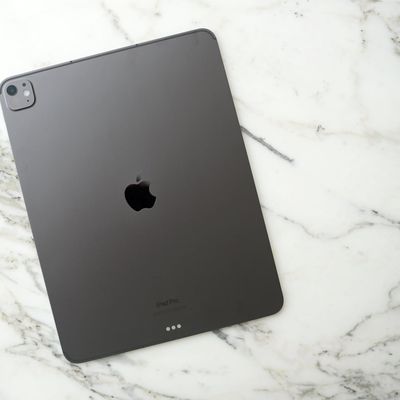
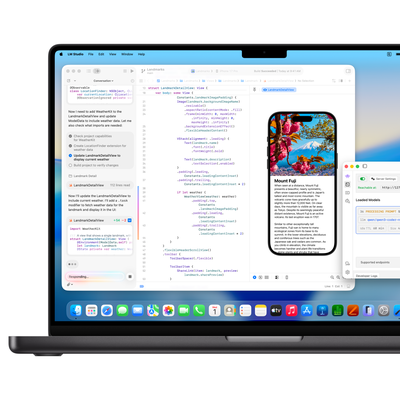
The M5 chip is currently available only in the 14-inch MacBook Pro, the latest iPad Pro, and the Apple Vision Pro. Higher-end M5 Pro and M5 Max variants are expected to follow in future Mac models.

Related Roundups: iPad Pro, MacBook Pro
Tags: M4, M5
Related Forum: MacBook Pro

Popular Stories

Aston Martin CarPlay Ultra Screen

Apple's CarPlay Ultra to Expand to These Vehicle Brands Later This Year

Sunday February 1, 2026 10:08 am PST by
Last year, Apple launched CarPlay Ultra, the long-awaited next-generation version of its CarPlay software system for vehicles. Nearly nine months later, CarPlay Ultra is still limited to Aston Martin's latest luxury vehicles, but that should change fairly soon. In May 2025, Apple said many other vehicle brands planned to offer CarPlay Ultra, including Hyundai, Kia, and Genesis. In his Powe...
Apple Logo Black

Apple's Next Launch is 'Imminent'

Sunday February 1, 2026 12:31 pm PST by
The calendar has turned to February, and a new report indicates that Apple's next product launch is "imminent," in the form of new MacBook Pro models. "All signs point to an imminent launch of next-generation MacBook Pros that retain the current form factor but deliver faster chips," Bloomberg's Mark Gurman said on Sunday. "I'm told the new models — code-named J714 and J716 — are slated...
Apple MacBook Pro M4 hero

New MacBook Pros Reportedly Launching Alongside macOS 26.3

Sunday February 1, 2026 5:42 am PST by
Apple is planning to launch new MacBook Pro models with M5 Pro and M5 Max chips alongside macOS 26.3, according to Bloomberg's Mark Gurman. "Apple's faster MacBook Pros are planned for the macOS 26.3 release cycle," wrote Gurman, in his Power On newsletter today. "I'm told the new models — code-named J714 and J716 — are slated for the macOS 26.3 software cycle, which runs from...
iOS 26

iOS 26.3 and iOS 26.4 Will Add These New Features to Your iPhone

Tuesday February 3, 2026 7:47 am PST by
We are still waiting for the iOS 26.3 Release Candidate to come out, so the first iOS 26.4 beta is likely still at least a week or two away. Following beta testing, iOS 26.4 will likely be released to the general public in March or April. Below, we have recapped known or rumored iOS 26.3 and iOS 26.4 features so far. iOS 26.3 iPhone to Android Transfer Tool iOS 26.3 makes it easier...
14 inch MacBook Pro Keyboard

Apple Changes How You Order a Mac

Saturday January 31, 2026 10:51 am PST by
Apple recently updated its online store with a new ordering process for Macs, including the MacBook Air, MacBook Pro, iMac, Mac mini, Mac Studio, and Mac Pro. There used to be a handful of standard configurations available for each Mac, but now you must configure a Mac entirely from scratch on a feature-by-feature basis. In other words, ordering a new Mac now works much like ordering an...

Top Rated Comments

Hank001 Avatar
15 weeks ago
If I can make a suggestion; articles like this one would make sense if you were to compare it to the last 4 or 5 versions of the same hardware. Most people aren't going to bother upgrading to each iteration of said device.

Make a table, make it readable, make it crystal clear what the gains are over the years. That would make for some proper journalism, people will be able to make a sound decision whether to upgrade or not, and they will be happy to read in-depth articles on all differences. And the author will be vastly more proud of said work.
Score: 42 Votes (Like | Disagree)
TheBeverage Avatar
15 weeks ago
So much effort wasted on “AI” junk. No mention of single threaded speeds, which is what the overwhelming majority of tasks rely on, especially the tasks a user buying a base chip is going to actually use it for.
Score: 19 Votes (Like | Disagree)
ilostmynick Avatar
15 weeks ago
How is the single threaded CPU performance? This is the most important for performance. I suspect there's a reason why this number isn’t publicly disclosed.
Score: 12 Votes (Like | Disagree)
Marzzz Avatar
15 weeks ago
My M4 MacBook Pro already has more than 10x the processing power I need for daily use, including recording audio in Logic Pro X. I’ll just stick to my “upgrade every 5 years” plan.
Score: 8 Votes (Like | Disagree)
CharlesShaw Avatar
15 weeks ago
Apple needs to stop improving their silicon every year because it's angering too many people.
Score: 8 Votes (Like | Disagree)
FloatingBones Avatar
15 weeks ago
The video Demystifying Apple’s AMX AI accelerator: when and why it outperforms the GPU ('//www.youtube.com/watch?v=TjfA9LVgHXk') is a great educational piece. The huge increase in matrix-multiply speed explains most of the "3.6x faster time to first token" speed improvements. IMHO, the money quote from that video:


because nowadays, the energy needed to transfer data significantly exceeds the energy needed to perform computations on the data
Fetching the matrixes to be multiplied only once makes a huge difference in the speed of the operation -- the bread-and-butter of LLM training and execution. Apparently, NVIDIA has had this feature for a long time on their Tensor Cores.

Petar posted this video right after the September 9 event. It's gratifying that Apple included that enhancement in the baseline M5 chip. It should make a big difference for the speed and energy expenditure of all locally-run LLMs. I'm hoping this enhancement will become available on the entire line of all future A-series processors, too.
Score: 7 Votes (Like | Disagree)