Researchers Develop New Tactile Technology That Could Enable a Pop-Up Keyboard on a Flat Smartphone Display
Researchers in the Future Interfaces Group at Carnegie Mellon this week highlighted a breakthrough in display technology that could make future screens more tactile through raised haptics. As noted by TechCrunch, the Future Interfaces Group shared a video and a research paper demonstrating a display that can grow small, physical bumps that can be felt under the fingers.
The technology could be used for tactile notifications, a pop-up keyboard that feels different under the fingers than the standard screen, buttons that remain inflated until pressed, pop-up custom-shaped buttons for controlling system functions, and more. One of the concepts demonstrated includes a pop-up music interface that displays raised music controls for playback, while another features a button on a smartphone that pulses up and down until it's pressed.
Researchers developed a flat panel that's using miniaturized hydraulic pumps to raise the surface through fluid. Each pump is individually controllable and can be activated separately to create dynamic, tactile bumps in a compact form factor.
The hardware is self-contained, lightweight, relatively slim at 5mm, and able to withstand the force of a normal touchscreen interaction.
At the current time, this is emergent technology that's owned by Carnegie Mellon, but it isn't hard to imagine future smartphones that use this kind of functionality. Apple has adopted haptic vibrations for touch-based feedback that's used for notifications and other system feedback, but raised haptics would add another dimension to the display.
Apple could use this kind of technology for a device that folds flat but has a pop-out keyboard when in use, plus there are likely multiple accessibility use cases for those who have sight problems. It's impossible to say whether this is functionality that we will see in Apple devices in the future, but it is an interesting concept.
Popular Stories
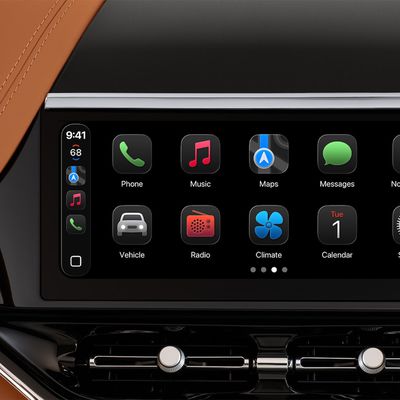
Last year, Apple launched CarPlay Ultra, the long-awaited next-generation version of its CarPlay software system for vehicles. Nearly nine months later, CarPlay Ultra is still limited to Aston Martin's latest luxury vehicles, but that should change fairly soon.
In May 2025, Apple said many other vehicle brands planned to offer CarPlay Ultra, including Hyundai, Kia, and Genesis.
In his Powe...
Apple today confirmed to Reuters that it has acquired Q.ai, an Israeli startup that is working on artificial intelligence technology for audio.
Apple paid close to $2 billion for Q.ai, according to sources cited by the Financial Times. That would make this Apple's second-biggest acquisition ever, after it paid $3 billion for the popular headphone and audio brand Beats in 2014.
Q.ai has...
The calendar has turned to February, and a new report indicates that Apple's next product launch is "imminent," in the form of new MacBook Pro models.
"All signs point to an imminent launch of next-generation MacBook Pros that retain the current form factor but deliver faster chips," Bloomberg's Mark Gurman said on Sunday. "I'm told the new models — code-named J714 and J716 — are slated...
Apple recently updated its online store with a new ordering process for Macs, including the MacBook Air, MacBook Pro, iMac, Mac mini, Mac Studio, and Mac Pro.
There used to be a handful of standard configurations available for each Mac, but now you must configure a Mac entirely from scratch on a feature-by-feature basis. In other words, ordering a new Mac now works much like ordering an...
Apple is planning to launch new MacBook Pro models with M5 Pro and M5 Max chips alongside macOS 26.3, according to Bloomberg's Mark Gurman.
"Apple's faster MacBook Pros are planned for the macOS 26.3 release cycle," wrote Gurman, in his Power On newsletter today.
"I'm told the new models — code-named J714 and J716 — are slated for the macOS 26.3 software cycle, which runs from...