Apple Silicon Likely to Benefit as TSMC Aims to Launch 2nm Chips by 2025

Apple chip supplier TSMC will begin production of advanced 2nm chips by 2025, in what is likely to contribute to a key future iteration of Apple silicon, Nikkei Asia reports.
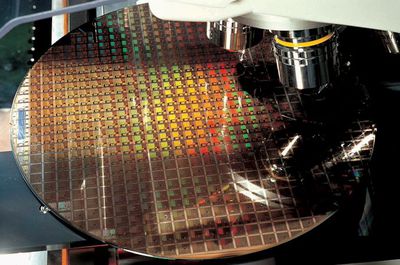
tsmc semiconductor chip inspection 678x452
TSMC made the announcement at an industry event on Thursday, explaining that its 2nm technology will be based on "nanosheet transistor architecture." Nanosheet architecture is a totally different chip technology from the FinFET infrastructure used for TSMC's current 5nm chips, delivering significant performance and efficiency improvements. Apple's latest chips, such as the M2 and A15 Bionic, are produced with TSMC's 5nm fabrication process.

TSMC's first 3nm chips are due to begin production in the second half of 2022. Apple could introduce custom silicon chips based on TSMC's ‌3nm‌ process as soon as this year, but other reports claim that the technology is likely to debut with the "M3" and "A17" chips in 2023.

The 2025 timeframe is the first official schedule for the company's 2nm chip production and is highly likely to be used for future Apple silicon chips. The 2nm fabrication process, also known simply as "N2," is expected to offer a 10 to 15 percent speed improvement at the same power or a 25 to 30 percent power reduction at the same speed compared to chips made with the supplier's ‌3nm‌ technology.

Popular Stories

Aston Martin CarPlay Ultra Screen

Apple's CarPlay Ultra to Expand to These Vehicle Brands Later This Year

Sunday February 1, 2026 10:08 am PST by
Last year, Apple launched CarPlay Ultra, the long-awaited next-generation version of its CarPlay software system for vehicles. Nearly nine months later, CarPlay Ultra is still limited to Aston Martin's latest luxury vehicles, but that should change fairly soon. In May 2025, Apple said many other vehicle brands planned to offer CarPlay Ultra, including Hyundai, Kia, and Genesis. In his Powe...
Apple Logo Black

Apple's Next Launch is 'Imminent'

Sunday February 1, 2026 12:31 pm PST by
The calendar has turned to February, and a new report indicates that Apple's next product launch is "imminent," in the form of new MacBook Pro models. "All signs point to an imminent launch of next-generation MacBook Pros that retain the current form factor but deliver faster chips," Bloomberg's Mark Gurman said on Sunday. "I'm told the new models — code-named J714 and J716 — are slated...
iOS 26

iOS 26.3 and iOS 26.4 Will Add These New Features to Your iPhone

Tuesday February 3, 2026 7:47 am PST by
We are still waiting for the iOS 26.3 Release Candidate to come out, so the first iOS 26.4 beta is likely still at least a week or two away. Following beta testing, iOS 26.4 will likely be released to the general public in March or April. Below, we have recapped known or rumored iOS 26.3 and iOS 26.4 features so far. iOS 26.3 iPhone to Android Transfer Tool iOS 26.3 makes it easier...
Apple MacBook Pro M4 hero

New MacBook Pros Reportedly Launching Alongside macOS 26.3

Sunday February 1, 2026 5:42 am PST by
Apple is planning to launch new MacBook Pro models with M5 Pro and M5 Max chips alongside macOS 26.3, according to Bloomberg's Mark Gurman. "Apple's faster MacBook Pros are planned for the macOS 26.3 release cycle," wrote Gurman, in his Power On newsletter today. "I'm told the new models — code-named J714 and J716 — are slated for the macOS 26.3 software cycle, which runs from...
iOS 26 Home Feature

Apple Gives Final Warning to Home App Users

Tuesday February 3, 2026 8:55 am PST by
In 2022, Apple introduced a new Apple Home architecture that is "more reliable and efficient," and the deadline to upgrade and avoid issues is fast approaching. In an email this week, Apple gave customers a final reminder to upgrade their Home app by February 10, 2026. Apple says users who do not upgrade may experience issues with accessories and automations, or lose access to their smart...

Top Rated Comments

HobeSoundDarryl Avatar
48 months ago
Fractions or they start spinning angstroms. There's always a smaller measure to adopt to support a marketing message. And don't let the laws of physics get in the way either. By super-fine hair-splitting, it can sound like whole number generations year over year while actually being only a fraction of what used to be a single generational number.

For example, if we put this in money terms, you would think a penny is as low as money goes. And yet, every gas station you pass adds the charge of 9/10ths of one cent... implying that someone else might bid that down to 8/10ths, 7/10ths, etc. But what if it gets down to 1/10th... then what??? Hello .0099, .0098, .0097, etc. That should buy a hundred years of generational gain claims.

There's always a smaller measure. And even when physics throws up a hard barrier, the fine hair that remains to max- er MIN- out the possibilities could be split into thousanths, ten thousandths, etc. The whole number will sound as familiar as whole numbers in nanometers now even if it is working within the fractional limits of only a single nanometer.

Besides, as others post often, even the current X nanometer process isn't literal. It's just a marketing "puffery" claim, apparently driven by the perceived need of a lower number in spite of the technology not actually representing the claim.


Funny how they call it 2nm while the transistor size or the absolute distance between the transistors is no where near 2 nanometers.
See "magical", "faster than 3090", 5Ge, "biggest network", "fastest network", 5G coverage map, "cool, ocean breeze" in coastal RE no matter how far you are from the coast, remarkable battery life claims, "lose weight without dieting or exercise", "lose 60 pounds in 6 weeks with this one small trick", 'elongation' pill/herbs/formula, how a swamp can become a natural preserve in RE puffery, "this miracle face cream will remove 20+ years of aging", wifi speed claims, broadband speed claims, SSD speed claims, Thunderbolt/USB speed claims, "this ship is unsinkable", diet candy, "It's easy... anyone can do it", "100% fruit- all natural", "I make $XXXXXX per month in only 1 hour per day and you can too", "Get rich quick with absolutely no selling", "The cure-all elixir", "Smoking cigarettes is good for you", "vaping is not as bad as smoking", "free range" <anything>, this bottled water is sourced from <exotic> place, kills 99.9% of germs, appearance of fast food in the ad vs. reality, "this one secret will make you rich beyond your wildest dreams", "valued at several times the price being sought today", "this time, it's different", any easy solution to make you thinner/more beautiful/younger looking, immediate ROI, "get in shape without setting foot in a gym", your personal data is completely secure in the cloud, favorable food label numbers until you check servings per container to realize that only a fraction of the single serving container is considered a serving, "everyone is obsessed with this <product>", "this one simple hack will do <wondrous things>", "free, unlimited fusion energy for all is only about 20-30 years away", just about anything politicians say that goes against common sense or hard science, "turn $2K into $200K in only 2 months", etc. The full list could probably exceed all storage available for the MR website.
Score: 21 Votes (Like | Disagree)
0194839 Avatar
48 months ago
I have great great respect for the engineers designing these chips. Very impressive engineering feat.
Score: 12 Votes (Like | Disagree)
headlessmike Avatar
48 months ago

What happens when they hit 1nm? Is it possible to go even smaller?
We start all over again with Ångström, where 1 nm = 10 Å. The big question is how far physics will let us go. Molecular bonds are typically 1-2 Å in length so we can’t go smaller than that with ordinary matter.
Score: 10 Votes (Like | Disagree)
iPadified Avatar
48 months ago

I’m British but why aren’t these machines made in the USA? The USA invented all of this in the first place - Silicon Valley, the clue is in the name of course.

Given the huge strategic importance of semiconductors to the modern world, why has a US company become critically dependent on suppliers outside of the USA?

Sadly in a world where Ukraine has happened we can’t be sure that seamless international trade is a given.

I’m not trying to rub anyone’s nose in it, I’m just genuinely curious - and I do realise that I’m going off topic.
Intel has fabs in USA but could not keep up with the nm race. Taiwan and South Korea have simply become very skilled to make state of the art chips. Cost is also an issue.

You raise a good point though and EU are already begun discussions about chip fabs on the European continent to ensure chips enough to feed the EU based industries. They already started before the Ukraine war due to chip shortage. Similarly, EU will ensure internal production of medicine, vaccines and other critical medical goods to not be too dependent on others in a pandemic. Despite UK living EU, I hope we will have a nice collaboration on critical products across the channel.
Score: 8 Votes (Like | Disagree)
NBAasDOGG Avatar
48 months ago
Funny how they call it 2nm while the transistor size or the absolute distance between the transistors is no where near 2 nanometers.
Score: 7 Votes (Like | Disagree)
mikethemartian Avatar
48 months ago

It would be a really interesting story to find out why cutting edge tech like this isn’t being produced in the USA but in Taiwan.

Why did companies in the USA seemingly drop the ball in not being able to offer this technology?
The machines TSMC uses come from ASML in Europe.
Score: 6 Votes (Like | Disagree)