Ever since Apple removed the headphone jack on the iPhone 7 in 2016, rumors have swirled that Apple eventually aims to ditch the Lightning port next for a completely portless design. Indeed, analysts originally predicted that the highest-end iPhone 13 would offer a "completely wireless experience." Of course, that didn't happen, but a portless iPhone 14 in 2022 looks just as unlikely, for the following reasons.
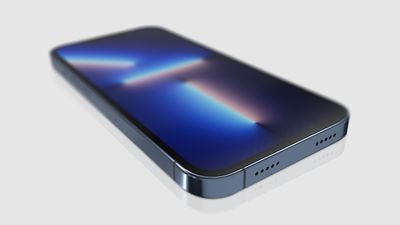
Apple's longtime goal has been to design an iPhone with no external ports or buttons for a clean, streamlined device, but significant hurdles still remain if it intends to provide a completely wireless charging and data transfer solution. As far as data is concerned, Apple would need to look beyond Bluetooth because of its bandwidth limitations and rely on a faster wireless protocol that allows iPhone data transfer at a speed that either matches or exceeds Lightning, otherwise the loss of the port would be seen as a backward step.
In fact, Apple has already developed such a protocol. MacRumors recently discovered that Apple Watch Series 7 models are equipped with a module that enables 60.5GHz wireless data transfer when placed on a proprietary magnetic dock with a corresponding 60.5GHz module. Apple probably doesn't advertise this capability because it's for internal use only. For example, Apple Store staff may use the dock to wirelessly restore an Apple Watch. It's unclear how fast its wireless data transfer is, but our understanding is that USB 2.0 speeds up to 480 Mbps might be possible. In other words, Lightning speed.
However, it's not just data transfer that would need to be achieved wirelessly. With no Lightning port, you wouldn't be able to physically connect your iPhone directly to a computer to reset an unresponsive iPhone through recovery mode. Unless Apple came up with an alternative at-home solution – a second iteration of MagSafe with high-speed data transfer capabilities, perhaps – the iPhone would have to go back to the Apple Store every time an over-air update or full device restore failed and borked the device, meaning more irritation and inconvenience for end users.
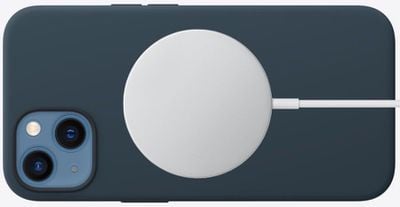
For argument's sake, let's say Apple introduced "MagSafe 2.0" alongside a portless iPhone 14 and solved these data/recovery issues. The existing MagSafe Charger provides up to 15W of peak power delivery (or 12W on the iPhone 12 mini and iPhone 13 mini) and charges a compatible iPhone less than half as fast as a wired 20W USB-C charger, so any new version of MagSafe would have to ramp up the juice considerably in order to come close to existing cable speeds.
Admittedly, Apple could probably pull off this feat (assuming it has shaken off its AirPower woes). You only have to look at its rivals to see what's already possible. Both the Google Pixel 6 and 6 Pro support up to 21W and 23W wireless charging speeds, respectively, while the OnePlus 9 Pro boasts 50W wireless charging speeds thanks to its next-generation Warp charger, which is capable of charging a dead phone to full power in 43 minutes. That's faster than an iPhone plugged directly into a 20W charger. Xiaomi is another leader in the field – the 5000mAh battery in its Mi 11 Ultra phone can be charged from 0% to 100% inside 30 minutes, wirelessly.
Yet despite these speed gains in wireless charging, an oft-overlooked problem is its generally poor energy efficiency. In 2020, Eric Ravenscraft of Debugger found that wireless charging uses around 47% more power than wired charging for the same amount of power. Unless Apple surprised us with a new version of MagSafe boasting unprecedented energy efficiency, ditching the Lightning port would surely run counter to its much-touted environmental policy.
And that's not the only eco-problem Apple would be inviting upon itself by going portless. Speaking out in 2020 against EU deliberations on requiring a universal port across all mobile devices, Apple said that removing the Lightning port from the iPhone would "create an unprecedented amount of electronic waste." It's not hard to see how this line of argument could be turned against Apple if it launched a portless iPhone in 2022. It would make millions of existing Lightning cables, charging docks, and other adapters in the wild obsolete overnight and ready for the trash.
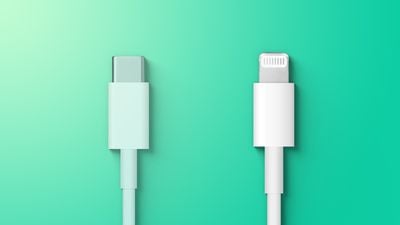
Of course, Apple could perhaps satisfy the European Commission by adopting USB-C, but that would just be swapping out one connector for another, committing the company to another cable standard for longer. Apple would effectively be kicking its vision of a portless iPhone further into the long grass. Indeed, analyst Ming-Chi Kuo predicts Apple will retain the Lightning connector on the iPhone for the "foreseeable future," and has no intention of switching to USB-C, which has a lower water specification than Lightning. As Kuo rightly notes, such a move would also be detrimental to Apple's profitable MFi business, which is why he believes Apple is more likely to switch directly to a portless model rather than first change to USB-C.
Given these interlacing obstacles, in spite of some iPhone 14 rumors, we expect Apple's next smartphone to continue to use Lightning ports with the option of MagSafe, until a more viable wireless charging solution comes along that allows for a portless iPhone design without the attendant disadvantages. So when could that be? Frankly, it's hard to say.
Back in 2016, Apple was rumored to be partnering with Energous to deliver a "true wireless charging" solution, but nothing has come from it so far. Apple is still believed to be researching new wireless charging technologies, and with the advent of MagSafe, the company is clearly still interested in innovating new ways to power devices without the mess of cables. How long we'll have to wait for one that powers a portless iPhone remains unknown.