Apple's Notarization Process Repeatedly Approved Malware for Mac - MacRumorsOpen MenuShow RoundupsShow Forums menuVisit ForumsOpen Sidebar
Skip to Content

Apple's Notarization Process Repeatedly Approved Malware for Mac

Apple mistakenly approved and notarized a common kind of malware for macOS on at least two occasions, reports TechCrunch.
bigSur

Apple requires developers to submit their apps for security checks to run on macOS in a process called "notarization." Notarization was required from the launch of macOS Catalina. If software has not been notarized, it will be blocked by default in macOS.

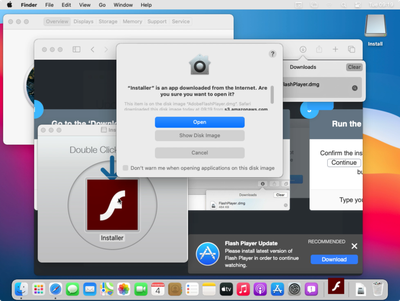
Peter Dantini and security researcher Patrick Wardle at Objective-See report that they have found the first malware for Mac that has been successfully notarized by Apple, even for the latest beta version of macOS Big Sur. The notarized malware was disguised as an Adobe Flash installer, which is an oft-used technique to convince unknowing users to install a trojan.

It contained "Shlayer" malware, which is said to be the "most common threat" to Macs in 2019. Shlayer is a kind of adware that intercepts encrypted web traffic, even from securely-encrypted HTTPS-enabled websites, and replaces it with its own ads to raise fraudulent ad revenue.

The researchers believe that Apple cannot have detected the malicious code when it was submitted for approval. The discovery is particularly surprising, given that the malware and its vehicle are extremely common. Upon notification from the researchers, Apple revoked the notarization.

"Malicious software constantly changes, and Apple's notarization system helps us keep malware off the Mac and allow us to respond quickly when it's discovered. Upon learning of this adware, we revoked the identified variant, disabled the developer account, and revoked the associated certificates. We thank the researchers for their assistance in keeping our users safe," an Apple spokesperson told TechCrunch.

In spite of Apple's statement, the researchers reported that the bad actors were able to get yet another malware trojan notarized soon after. The second notarized payloads were still approved by Apple as of yesterday.

Earlier this month, a new kind of Mac malware was discovered that infects via Xcode and supposedly can infiltrate the Mac App Store, undetected by Apple.
Tag: Malware
Related Forum: macOS Big Sur

Popular Stories

bug security vulnerability issue fix larry

CrashStealer Malware Impersonates Apple Tool to Steal Mac Passwords and Crypto

Wednesday July 15, 2026 4:14 pm PDT by
Mac users should watch out for macOS malware called CrashStealer, according to Jamf Threat Labs. The malware impersonates Apple's crash reporting framework, and it's meant to steal all kinds of sensitive information. CrashStealer collects browser data, password manager data, cryptocurrency wallet extensions, and keychain data, and Jamf first noticed it circulating in a fake Apple-notarized...
Apple Event Logo

Apple Working on All-New Operating System

Wednesday July 29, 2026 11:39 am PDT by
Apple is developing an all-new operating system that is essentially a mix of tvOS, watchOS, and iOS, according to Bloomberg's Mark Gurman. In a report this week, he said the operating system will feature a grid of icons, widgets, and apps, along with customizable clock faces. The new software platform is intended for Apple's long-rumored smart home hub. With built-in facial recognition,...
imac video apple feature

Apple Made Its Second-Biggest Acquisition Ever This Year

Wednesday July 29, 2026 12:03 pm PDT by
Apple this year acquired Israeli startup Q.ai for close to $2 billion, according to the Financial Times. That would make this Apple's second-biggest acquisition ever, after it paid $3 billion for the popular headphone maker Beats in 2014. This is also the largest known Apple acquisition since the company purchased Intel's smartphone modem business and patents for $1 billion in 2019. Q.ai...

Top Rated Comments

larrylaffer Avatar
77 months ago
Apple's gatekeeping here must be truly awful. These people disguised their software as coming from one of the world's biggest software vendors, and it still made it through?
Score: 17 Votes (Like | Disagree)
77 months ago
If I never again hear of Flash for the rest of my life, it will still be too soon.
Score: 12 Votes (Like | Disagree)
77 months ago

Just another reason why we should be allowed to install 3rd party apps on iOS with out the App Store. Just because Apple approves the app (I know it’s for macOS in this particular article) doesn’t mean it’s guaranteed to be safe.
This is a totally different case. "Notarization" is just Apple running an automated malware scan on the apps, it's not a manual review by an actual person.
Score: 11 Votes (Like | Disagree)
CarlJ Avatar
77 months ago
An actual real-life notary public doesn’t certify anything about the content of the document you’re signing, they only witness that it was actually you that signed it.

I expected that Apple’s notarization service was primarily designed to associate an app with a developer, and register the pairing with Apple, so that if the app subsequently starting doing something really unsavory in the real world, posing a threat to customers, it could be shut off by Apple.
Score: 10 Votes (Like | Disagree)
cmaier Avatar
77 months ago

Proof that their notorization is worthless. But it sounds good on paper.
No it's not. Notarization is not malware detection. It ensures that the binary actually came from who it claims to have come from. That's it. Just like a notary public proves that a document was signed by the person who claims to have signed it, and doesn't prove that the contents of the document are true.

This is a weird news article.
Score: 8 Votes (Like | Disagree)
BigMcGuire Avatar
77 months ago
Patrick Wardle at Objective-See ('https://objective-see.com/blog/blog_0x4E.html') --- This guy is doing a lot of great work. I run several of his apps. Very cool!
Score: 6 Votes (Like | Disagree)

🔗 Related Apple News & Rumors

Stay updated with the latest Apple ecosystem news and verified rumors