Report: Apple Investing $330 Million in Taiwanese Factory Where MicroLED Display Development Will Be 'Top Priority' - MacRumorsOpen MenuShow RoundupsShow Forums menuVisit ForumsOpen Sidebar
Skip to Content

Report: Apple Investing $330 Million in Taiwanese Factory Where MicroLED Display Development Will Be 'Top Priority'

Apple is reportedly weighing up a $330 million investment in a Taiwanese factory to manufacture both LED and MicroLED displays for future iPhones, iPads, MacBooks, and other devices. According to Taiwan Sourcing Service Provider (CENS), Apple is teaming up on the new factory with LED producer Epistar and LCD panel maker AU Optronics.
microled

Apple is teaming up on the new factory with Epistar, Taiwan's top LED producer, and Taiwanese LCD panel maker, AU Optronics. The plant will be located in the Longtan branch of the Hsinchu Science Park and Apple's total investment is estimated at NT$10 billion (US$334 million).

The new plant would be an expansion of Apple's operations in the area, and the company has reportedly sent a development team to Taiwan to work on the project. Apple has long been expected to use of Mini-LED and Micro LED across a range of products, including at times the 2020 Apple Watch, and now a future refresh of the 16-inch MacBook Pro.

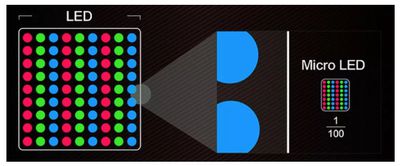
The report highlights the advantages of Mini-LED and MicroLED screens over LCD and OLED displays, including being thinner and more energy efficient. For example, the power consumption of MicroLED screens is only one-tenth that of LCD displays, and the color saturation is close to ‌OLED‌.

Like OLED, micro-LED is self-luminous. However, compared with OLED, micro-LED can support a higher brightness, higher dynamic range, and wider color gamut, all the while achieving a faster update rate, wider viewing angle, and lower power consumption, all qualities favored by Apple.

According to the report, owing to the difficulties involved in developing MicroLED technology, early designs will rely on Mini-LEDs that are somewhere in between traditional LED and MicroLED technology. However, Apple still considers MicroLED technology to be the "top priority."

Apple has six mini-LED products in the works that are set to debut in 2020 and 2021, according to Apple analyst Ming-Chi Kuo. Apple is said to be debuting the technology in a high-end 12.9-inch ‌iPad Pro‌, which will launch in the fall, a 27-inch iMac Pro, a 14.1-inch MacBook Pro, a 16-inch ‌‌‌MacBook Pro‌‌‌, a 10.2.-inch iPad, and a 7.9-inch ‌‌‌iPad‌‌‌ mini.

Kuo has not mentioned launch dates for the other devices with the exception of the ‌‌‌iMac‌ Pro‌‌, which Kuo expects to launch in the fourth quarter of 2020, and the 7.9-inch ‌‌‌iPad‌‌‌ mini, which he says will launch in 2020.

Apple has also reportedly been testing prototype ‌Apple Watch‌ models with MicroLED displays since 2017. While rumors have suggested an ‌Apple Watch‌ with a microLED display could launch as early as 2020, Twitter leaker @L0vetodream on Sunday poured cold water on that prediction by claiming that this year's Apple Watch Series 6 will use the same OLED display as previous models.
Popular Stories

Apple Event Logo

Apple Working on All-New Operating System

Wednesday July 29, 2026 11:39 am PDT by
Apple is developing an all-new operating system that is essentially a mix of tvOS, watchOS, and iOS, according to Bloomberg's Mark Gurman. In a report this week, he said the operating system will feature a grid of icons, widgets, and apps, along with customizable clock faces. The new software platform is intended for Apple's long-rumored smart home hub. With built-in facial recognition,...
imac video apple feature

Apple Made Its Second-Biggest Acquisition Ever This Year

Wednesday July 29, 2026 12:03 pm PDT by
Apple this year acquired Israeli startup Q.ai for close to $2 billion, according to the Financial Times. That would make this Apple's second-biggest acquisition ever, after it paid $3 billion for the popular headphone maker Beats in 2014. This is also the largest known Apple acquisition since the company purchased Intel's smartphone modem business and patents for $1 billion in 2019. Q.ai...
Dynamic Island iPhone 18 Pro Feature

iPhone 18 Pro: Twelve Changes Coming to Apple's Next Flagship

Thursday July 30, 2026 3:43 am PDT by
We're less than two months out from the launch of Apple's premium next-generation smartphone lineup, and while we're not expecting a dramatic change in terms of functionality, there are still several enhancements rumored to be coming to the iPhone 18 Pro and iPhone 18 Pro Max. One thing worth noting is that Apple is reportedly planning a major change to its iPhone release cycle this year,...

Top Rated Comments

fokmik Avatar
81 months ago
Very good investment since the microLED will be the top display for the next 20-25 years
Score: 8 Votes (Like | Disagree)
CarlJ Avatar
81 months ago

NanoLED or nothing! :mad:
They’re skipping over NanoLED and going to PicoLED.

Though I won’t be upgrading until FemtoLED.
Score: 2 Votes (Like | Disagree)
bobob Avatar
81 months ago
NanoLED or nothing! :mad:
Score: 2 Votes (Like | Disagree)
LFC2020 Avatar
81 months ago
Not long now!!! 😍🤗💰💻
Score: 2 Votes (Like | Disagree)
81 months ago

There are plenty of uLED at 500ppi+ some 1000ppi, and even up to 2000ppi. ( You can do a simple google search )

It will first come to Apple Watch which has the PPI range of iPhone ( 326PPi ) . And it is a low volume product ( Low by Apple's standard ). Apple Could even have Apple Watch Special Edition or Pro Edition with uLED and charge it $200+ more just to test out the test and production issues.

iPhone is an extremely high volume product. That is why it is hard to put any latest tech into it. The Pro and Mainline series each sold for about 50M unit per year. There are no other SKUs / Models from other vendor which is close to that number in a Global Scale.
Relatively low volume *and* smaller screens are easier to produce without flaws than large ones.
Score: 1 Votes (Like | Disagree)
81 months ago
Thomas, post: 28521254, member: 1021539"]
Can someone logically explain why µLED should first come to something like the Apple Watch that relies on a high DPI display when the major challenge in µLED technology is shrinking it? AFAIK the highest DPI display to date has 220 PPI. ('https://www.eenewseurope.com/news/auo-partners-playnitride-228-ppi-flexible-microleds')
And according to other rumors production yield on such high DPI µLED is extremely low...
Expanding on what ksec said, display components are usually manufactured in large “sheets“ and then diced up into individual device sizes. Yield issues near or in the production stage will often be problems affecting small portions of each sheet. (The same general logic applies to post-dicing steps.) If your sheet was destined to become a thousand Apple Watch screens, you’ll probably be getting quite a few perfectly unaffected parts out of problematic sheets; if you were dicing for just four massive Pro Display Max screens, you’d have to bin the whole sheet or make your customers very unhappy...
Score: 1 Votes (Like | Disagree)

🔗 Related Apple News & Rumors

Stay updated with the latest Apple ecosystem news and verified rumors