Wi-Fi Alliance Simplifies Wi-Fi Naming Scheme With Upcoming 'Wi-Fi 6' Release
The Wi-Fi Alliance, dedicated to developing new wireless networking standards, is planning to make Wi-Fi naming simpler with the upcoming launch of the newest Wi-Fi standard, 802.11ax.
802.11ax will be known as "Wi-Fi 6," making it easier for Wi-Fi users to understand the difference between 802.11ax, 802.11ac, and 802.11n.
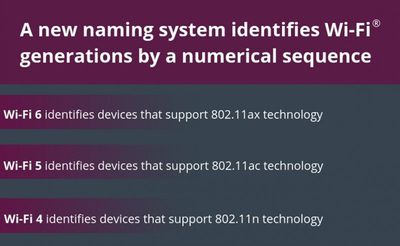
With the launch of Wi-Fi 6, 802.11ac will be known as "Wi-Fi 5," while 802.11n will be known as "Wi-Fi 4."
"For nearly two decades, Wi-Fi users have had to sort through technical naming conventions to determine if their devices support the latest Wi-Fi," said Edgar Figueroa, president and CEO of Wi-Fi Alliance. "Wi-Fi Alliance is excited to introduce Wi-Fi 6, and present a new naming scheme to help industry and Wi-Fi users easily understand the Wi-Fi generation supported by their device or connection."
Wi-Fi 6 will introduce higher data rates, increased capacity, better performance in dense environments like concerts and sporting events, and improved power efficiency so Wi-Fi won't eat up as much battery on future devices.
In 802.11ax tests, speeds of up to 4.8Gbit/s over the 5GHz band have been reached. In demonstrations at CES, speeds maxed out at 11Gbit/s.
The new capabilities being introduced are outlined below, as specified by the Wi-Fi Alliance.
- Uplink and downlink orthogonal frequency division multiple access (OFDMA) increases efficiency and lowers latency for high demand environments
- 1024 quadrature amplitude modulation mode (1024-QAM) enables peak gigabit speeds for emerging, bandwidth-intensive use cases
- Improved medium access control (MAC) control signaling increases throughput and capacity while reducing latency
- Increased symbol durations make outdoor network operations more robust
Wi-Fi 6 is expected to provide performance improvements to smart home setups with multiple Internet of Things devices, as well as businesses and those running large-scale deployments. The Wi-Fi 6 standard is expected to be finalized next year.
Popular Stories
Last year, Apple launched CarPlay Ultra, the long-awaited next-generation version of its CarPlay software system for vehicles. Nearly nine months later, CarPlay Ultra is still limited to Aston Martin's latest luxury vehicles, but that should change fairly soon.
In May 2025, Apple said many other vehicle brands planned to offer CarPlay Ultra, including Hyundai, Kia, and Genesis.
In his Powe...
The calendar has turned to February, and a new report indicates that Apple's next product launch is "imminent," in the form of new MacBook Pro models.
"All signs point to an imminent launch of next-generation MacBook Pros that retain the current form factor but deliver faster chips," Bloomberg's Mark Gurman said on Sunday. "I'm told the new models — code-named J714 and J716 — are slated...
Apple is planning to launch new MacBook Pro models with M5 Pro and M5 Max chips alongside macOS 26.3, according to Bloomberg's Mark Gurman.
"Apple's faster MacBook Pros are planned for the macOS 26.3 release cycle," wrote Gurman, in his Power On newsletter today.
"I'm told the new models — code-named J714 and J716 — are slated for the macOS 26.3 software cycle, which runs from...
We are still waiting for the iOS 26.3 Release Candidate to come out, so the first iOS 26.4 beta is likely still at least a week or two away. Following beta testing, iOS 26.4 will likely be released to the general public in March or April.
Below, we have recapped known or rumored iOS 26.3 and iOS 26.4 features so far.
iOS 26.3
iPhone to Android Transfer Tool
iOS 26.3 makes it easier...
Apple recently updated its online store with a new ordering process for Macs, including the MacBook Air, MacBook Pro, iMac, Mac mini, Mac Studio, and Mac Pro.
There used to be a handful of standard configurations available for each Mac, but now you must configure a Mac entirely from scratch on a feature-by-feature basis. In other words, ordering a new Mac now works much like ordering an...