Google's iOS and Android Apps Track and Store Location Data With Location History Disabled

Some Google apps on iOS and Android devices continue to store location history even with the setting disabled, according to a new AP report citing data collected by computer science researchers at Princeton.

Location History, a feature available in Google apps like Google Maps, is an option that allows the app to display the locations that you've visited in a timeline. Princeton researcher Gunnar Acar turned off the Location History option in his Google account, but his devices continued to record the locations he had visited.
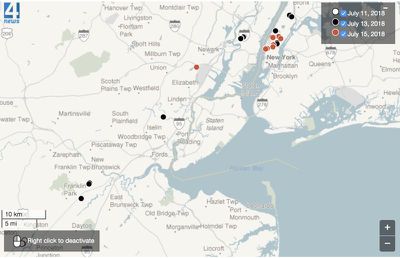
googledatacollection

Data collected from a Princeton researcher on an Android phone with Location History disabled

It appears that even with Location History paused, some Google apps are ignoring the setting and continue to store time-stamped location data, due to confusing data collection policies that allow other app features to also store location information.

For example, Google stores a snapshot of where you are when you merely open its Maps app. Automatic daily weather updates on Android phones pinpoint roughly where you are. And some searches that have nothing to do with location, like "chocolate chip cookies," or "kids science kits," pinpoint your precise latitude and longitude -- accurate to the square foot -- and save it to your Google account.

While Princeton's research focused on Android devices, independent AP testing confirmed that iPhones are exhibiting the same behavior when used with Google apps.

In response to a query about the Location History tracking, Google said that it is clear about its location policies. As it turns out though, the way Google collects location data is confusing and misleading.

"There are a number of different ways that Google may use location to improve people's experience, including: Location History, Web and App Activity, and through device-level Location Services," a Google spokesperson said in a statement to the AP. "We provide clear descriptions of these tools, and robust controls so people can turn them on or off, and delete their histories at any time."

According to Google, users need to turn off "Web and App Activity," a setting enabled by default, to prevent all location data on iOS and Android devices from being saved to a Google account. Leaving "Web and App Activity" enabled while turning off "Location History" prevents Google from adding movements to the built-in timeline, but it does not stop Google from collecting other location information.

This location data collected by Google can be found under myactivity.google.com, but as the AP points out, this information is scattered under different headers often unrelated to location.

To be clear, Google is not illicitly collecting location data, but it is obfuscating its location data policies and collecting data through features that do not mention location information. Many people may not know these Google features are enabled at all, as it's a default setting.

Google's only mention that it may continue storing some location data is in a popup that appears when Location History is disabled through the Google account settings. This popup states that "some location data may be saved as part of your activity on other Google services, like Search and Maps."

On iPhone, when Location History is disabled via settings in Google apps, it says "None of your Google apps will be able to store location data in Location History." As the AP points out, this statement is true but misleading, because while location data isn't stored in Location History, it's still stored under "My Activity."

Location information stored in "My Activity" is used for ad targeting purposes.

Both "Web and App Activity" and "Location History" need to be disabled to prevent Google from collecting any location data, which can be done through the user settings of a Google account. On iOS devices, not using Google apps and disabling location services for Google apps is also an effective method for preventing Google from collecting location data.

Tag: Google

Popular Stories

Aston Martin CarPlay Ultra Screen

Apple's CarPlay Ultra to Expand to These Vehicle Brands Later This Year

Sunday February 1, 2026 10:08 am PST by
Last year, Apple launched CarPlay Ultra, the long-awaited next-generation version of its CarPlay software system for vehicles. Nearly nine months later, CarPlay Ultra is still limited to Aston Martin's latest luxury vehicles, but that should change fairly soon. In May 2025, Apple said many other vehicle brands planned to offer CarPlay Ultra, including Hyundai, Kia, and Genesis. In his Powe...
Apple Logo Black

Apple's Next Launch is 'Imminent'

Sunday February 1, 2026 12:31 pm PST by
The calendar has turned to February, and a new report indicates that Apple's next product launch is "imminent," in the form of new MacBook Pro models. "All signs point to an imminent launch of next-generation MacBook Pros that retain the current form factor but deliver faster chips," Bloomberg's Mark Gurman said on Sunday. "I'm told the new models — code-named J714 and J716 — are slated...
iOS 26

iOS 26.3 and iOS 26.4 Will Add These New Features to Your iPhone

Tuesday February 3, 2026 7:47 am PST by
We are still waiting for the iOS 26.3 Release Candidate to come out, so the first iOS 26.4 beta is likely still at least a week or two away. Following beta testing, iOS 26.4 will likely be released to the general public in March or April. Below, we have recapped known or rumored iOS 26.3 and iOS 26.4 features so far. iOS 26.3 iPhone to Android Transfer Tool iOS 26.3 makes it easier...
Apple MacBook Pro M4 hero

New MacBook Pros Reportedly Launching Alongside macOS 26.3

Sunday February 1, 2026 5:42 am PST by
Apple is planning to launch new MacBook Pro models with M5 Pro and M5 Max chips alongside macOS 26.3, according to Bloomberg's Mark Gurman. "Apple's faster MacBook Pros are planned for the macOS 26.3 release cycle," wrote Gurman, in his Power On newsletter today. "I'm told the new models — code-named J714 and J716 — are slated for the macOS 26.3 software cycle, which runs from...
iOS 26 Home Feature

Apple Gives Final Warning to Home App Users

Tuesday February 3, 2026 8:55 am PST by
In 2022, Apple introduced a new Apple Home architecture that is "more reliable and efficient," and the deadline to upgrade and avoid issues is fast approaching. In an email this week, Apple gave customers a final reminder to upgrade their Home app by February 10, 2026. Apple says users who do not upgrade may experience issues with accessories and automations, or lose access to their smart...

Top Rated Comments

Santabean2000 Avatar
98 months ago
Is anyone really surprised..?
Score: 69 Votes (Like | Disagree)
RedGala Avatar
98 months ago
Enough of a reason to ditch android and all google apps
Score: 61 Votes (Like | Disagree)
macduke Avatar
98 months ago
If you didn't expect this then you've been living under a rock. This is Google all day every day. I'd be more surprised if they didn't do this.
Score: 46 Votes (Like | Disagree)
rtomyj Avatar
98 months ago
Is anyone really surprised..?
Exactly. I cannot fathom how people can use Google services anymore. All their services have decent alternatives (yes even search).

Now they’re are double dipping: ads/tracking and premium prices on hardware... Do no evil my ass.
Score: 38 Votes (Like | Disagree)
m0sher Avatar
98 months ago
Well looks like I’ll be moving to Apple Maps exclusively.

I’m glad Apple has been doing a lot of revamping and getting it up to par, couldn’t come at a better time.

Apple data privacy is hands-down better than Google’s data mining activity where Goggle even does it against your will.

Can’t wait for iOS 12 this fall.
Score: 28 Votes (Like | Disagree)
0071284 Avatar
98 months ago
Isn’t this a violation of Apple’s terms of service? If so, time to remove their apps like others who are removed for violations.
Score: 23 Votes (Like | Disagree)