Third-Party macOS Security Tools Vulnerable to Malware Code-Signing Bypasses for Years

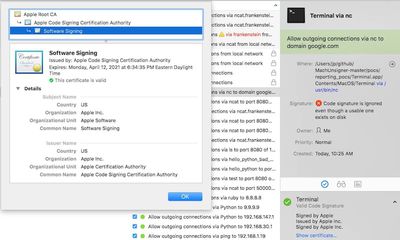
Hackers have had an "easy way" to get certain malware past signature checks in third-party security tools since Apple's OS X Leopard operating system in 2007, according to a detailed new report today by Ars Technica. Researchers discovered that hackers could essentially trick the security tools -- designed to sniff out suspiciously signed software -- into thinking the malware was officially signed by Apple while they in fact hid malicious software.
macos code signing bypass
The researchers said that the signature bypassing method is so "easy" and "trivial" that pretty much any hacker who discovered it could pass off malicious code as an app that appeared to be signed by Apple. These digital signatures are core security functions that let users know the app in question was signed with the private key of a trusted party, like Apple does with its first-party apps.

Joshua Pitts, senior penetration testing engineer for security firm Okta, said he discovered the technique in February and informed Apple and the third-party developers about it soon after. Okta today also published information about the bypass, including a detailed disclosure timeline that began on February 22 with a report submitted to Apple and continues to today's public disclosure.

Ars Technica broke down how the method was used and which third-party tools are affected:

The technique worked using a binary format, alternatively known as a Fat or Universal file, that contained several files that were written for different CPUs used in Macs over the years, such as i386, x86_64, or PPC. Only the first so-called Mach-O file in the bundle had to be signed by Apple. At least eight third-party tools would show other non-signed executable code included in the same bundle as being signed by Apple, too.

Affected third-party tools included VirusTotal, Google Santa, Facebook OSQuery, the Little Snitch Firewall, Yelp, OSXCollector, Carbon Black’s db Response, and several tools from Objective-See. Many companies and individuals rely on some of the tools to help implement whitelisting processes that permit only approved applications to be installed on a computer, while forbidding all others.

Developer Patrick Wardle spoke on the topic, explaining that the bypass was due to ambiguous documentation and comments provided by Apple regarding the use of publicly available programming interfaces that make digital signature checks function: "To be clear, this is not a vulnerability or bug in Apple's code... basically just unclear/confusing documentation that led to people using their API incorrectly." It's also not an issue exclusive to Apple and macOS third-party security tools, as Wardle pointed out: "If a hacker wants to bypass your tool and targets it directly, they will win."

For its part, Apple was said to have stated on March 20 that it did not see the bypass as a security issue that needed to be directly addressed. On March 29, the company updated its documentation to be more clear on the matter, stating that "third-party developers will need to do additional work to verify that all of the identities in a universal binary are the same if they want to present a meaningful result."
Popular Stories

Aston Martin CarPlay Ultra Screen

Apple's CarPlay Ultra to Expand to These Vehicle Brands Later This Year

Sunday February 1, 2026 10:08 am PST by
Last year, Apple launched CarPlay Ultra, the long-awaited next-generation version of its CarPlay software system for vehicles. Nearly nine months later, CarPlay Ultra is still limited to Aston Martin's latest luxury vehicles, but that should change fairly soon. In May 2025, Apple said many other vehicle brands planned to offer CarPlay Ultra, including Hyundai, Kia, and Genesis. In his Powe...
Apple Logo Black

Apple Just Made Its Second-Biggest Acquisition Ever After Beats

Thursday January 29, 2026 10:07 am PST by
Apple today confirmed to Reuters that it has acquired Q.ai, an Israeli startup that is working on artificial intelligence technology for audio. Apple paid close to $2 billion for Q.ai, according to sources cited by the Financial Times. That would make this Apple's second-biggest acquisition ever, after it paid $3 billion for the popular headphone and audio brand Beats in 2014. Q.ai has...
Apple Logo Black

Apple's Next Launch is 'Imminent'

Sunday February 1, 2026 12:31 pm PST by
The calendar has turned to February, and a new report indicates that Apple's next product launch is "imminent," in the form of new MacBook Pro models. "All signs point to an imminent launch of next-generation MacBook Pros that retain the current form factor but deliver faster chips," Bloomberg's Mark Gurman said on Sunday. "I'm told the new models — code-named J714 and J716 — are slated...
14 inch MacBook Pro Keyboard

Apple Changes How You Order a Mac

Saturday January 31, 2026 10:51 am PST by
Apple recently updated its online store with a new ordering process for Macs, including the MacBook Air, MacBook Pro, iMac, Mac mini, Mac Studio, and Mac Pro. There used to be a handful of standard configurations available for each Mac, but now you must configure a Mac entirely from scratch on a feature-by-feature basis. In other words, ordering a new Mac now works much like ordering an...
Apple MacBook Pro M4 hero

New MacBook Pros Reportedly Launching Alongside macOS 26.3

Sunday February 1, 2026 5:42 am PST by
Apple is planning to launch new MacBook Pro models with M5 Pro and M5 Max chips alongside macOS 26.3, according to Bloomberg's Mark Gurman. "Apple's faster MacBook Pros are planned for the macOS 26.3 release cycle," wrote Gurman, in his Power On newsletter today. "I'm told the new models — code-named J714 and J716 — are slated for the macOS 26.3 software cycle, which runs from...

Top Rated Comments

OldSchoolMacGuy Avatar
100 months ago
These companies are prioritizing speed for security. We can assume they'll now implement proper checks, but it will come at the cost of speed.

I'm sure most won't bother to read this article and blame Apple, but the real blame here is with developers including Little Snitch, xFence, and Facebook's OSquery. They're the ones that failed to properly check these signatures.
Score: 12 Votes (Like | Disagree)
ThunderSkunk Avatar
100 months ago
Wow, but somehow, I'm less concerned about the security threat than I am excited to have discovered the job title "Senior Penetration Testing Engineer". ...someone's up for a performance review & promotion!
Score: 6 Votes (Like | Disagree)
skin88 Avatar
100 months ago
Does Apple give a damn?? Obviously not. It's focused now on important kindergarten stuff like animojis and AR gimmicks.
Score: 5 Votes (Like | Disagree)
slimtastic Avatar
100 months ago
This is very bad. Thank goodness for white-hats who find this stuff out.
Score: 4 Votes (Like | Disagree)
konqerror Avatar
100 months ago

I'm sure most won't bother to read this article and blame Apple, but the real blame here is with developers including Little Snitch, xFence, and Facebook's OSquery. They're the ones that failed to properly check these signatures.
It's Apple's fault. When 8 separate developers use the API in the wrong way, there's an issue with the API and instructions.
Score: 4 Votes (Like | Disagree)
OldSchoolMacGuy Avatar
100 months ago
It's Apple's fault. When 8 separate developers use the API in the wrong way, there's an issue with the API and instructions.
No, it's really not. It's the developers responsibility to use the proper security procedures in their app. Is it the states fault that people fail to follow speed limit signs?
Score: 2 Votes (Like | Disagree)