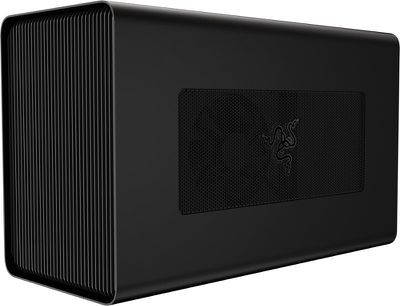
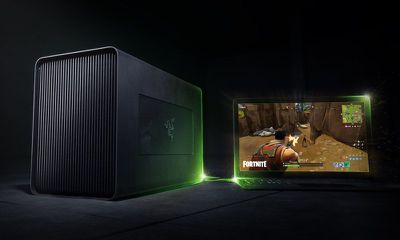
Razer today announced the launch of its latest external graphics enclosure, the Core X, and alongside the debut of the new accessory, the company is also adding Mac support to its enclosure lineup.
Both the new Core X and the existing Core V2 external graphics enclosure are now compatible with all Macs that offer support for Thunderbolt 3, including the MacBook Pro, iMac, and iMac Pro.
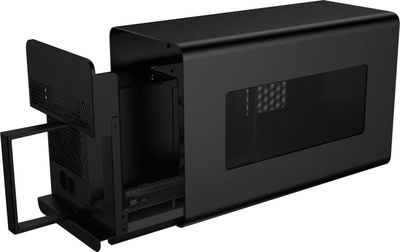
The Razer Core X, which also works with Windows machines, has been designed based on customer feedback Razer received after releasing the Core V2. Users wanted a wider external graphics enclosure able to fit larger 3 slot PCIe graphics cards, which the Core X delivers along with better cooling capabilities.
Razer designed the Core X to be future proof with the aforementioned larger enclosure and a 650W power supply that offers enough power to support all graphics cards on the market today and those coming in the future. While this is larger than the Core V2, Razer still designed it with desktop use in mind, so it's relatively slim and compact.
For those unfamiliar with Razer's Core series, the enclosures are designed to add additional graphics power to a Mac or a PC for tasks like gaming and system intensive workflows. With an external graphics enclosure, a machine not normally capable of handling GPU-intensive tasks can be hooked up to a powerful GPU. You will, of course, need to purchase a GPU alongside the Razer Core accessories - these are just enclosures.
To use the Razer Core X with a Mac, the machine must be running macOS 10.13.4 or later, and the Razer Core X needs to be equipped with an AMD Radeon card. It is not compatible with NVIDIA cards when used with a Mac at this time.
Pairing the Core X to a Mac is as simple as plugging the accessory into the Thunderbolt port on a compatible machine, with no restarting or fussing with settings needed. 100W passthrough charging is supported, so even the 15-inch MacBook Pro can charge when plugged into the Core X.
Good looking piece of kit. At $300 it's still a dubious value proposition- unless you're comparison shopping against higher-spec versions of the same lineup from Apple (i.e. base-model MBP vs high end MBP). In that light, you might conceivably get away with (much) more GPU power for less cash, even with the expense of this box.
Pity that TB2 models are left in the dust, but such is the way of things.
I need a Thunderbolt 2 version so I can bypass the unstable D300 cards in my 2013 Mac Pro. The D300s have the same fault as the D500 and D700s that Apple are replacing, but Apple won't admit it and fix them.
Maybe the dust in the years... anyway any eGPU is hardware compatible just need Thunderbolt 2-3 Apple adapter. Sadly there is not support in lastest macOS version, but there is an hack for this: https://egpu.io/forums/mac-setup/script-fr34ks-macos-egpu-sh-one-script-all-solutions-fully-automated/
I need a Thunderbolt 2 version so I can bypass the unstable D300 cards in my 2013 Mac Pro. The D300s have the same fault as the D500 and D700s that Apple are replacing, but Apple won't admit it and fix them.
Friday October 30, 2026 3:20 pm PDT by Joe Rossignol
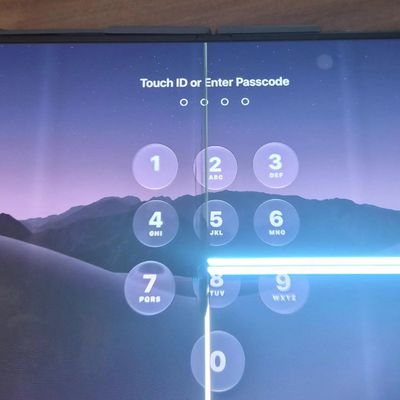
In a memo shared with Apple Stores and Apple Authorized Service Providers this week, and later obtained by MacRumors, Apple provided technicians with guidance on how to diagnose and address the iPhone Duo's inner display cracking issue.
If a customer reports the issue, Apple advised technicians to inspect the iPhone Duo and repair or replace it in accordance with their standard procedures....
Thursday October 29, 2026 1:47 pm PDT by Joe Rossignol
While the new iPad mini has an OLED display, the device does not support ProMotion, meaning the display's refresh rate is limited to 60Hz instead of 120Hz.
ProMotion support would have allowed for the iPad mini's refresh rate to automatically adjust from 10Hz to 120Hz depending on the content being displayed, but evidently Apple has kept the feature exclusive to the iPad Pro among iPad...
Thursday October 29, 2026 11:52 am PDT by Joe Rossignol
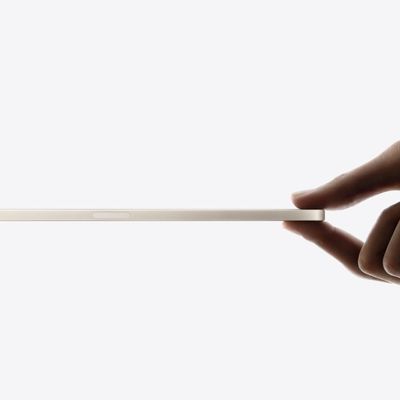
In the U.S. and most other countries, Apple's website shows the new iPad mini being held by pinched fingers, but this is not the case in South Korea.
The new iPad mini shown with pinched fingers on Apple's website in the U.S.
On its South Korean website, Apple simply shows an image of the iPad mini on its own.
The new iPad mini shown without pinched fingers on Apple's website in South Korea ...


















































Top Rated Comments
At this rate we’ll be sliding Mac mini’s into a 2019 Mac Pro GPU enclosure, like slices of bread into a toaster.
Pity that TB2 models are left in the dust, but such is the way of things.