The Next Generation Apple Watch Could Identify Users by Their Heart Rate - MacRumorsOpen MenuShow RoundupsShow Forums menuVisit ForumsOpen Sidebar
Skip to Content

The Next Generation Apple Watch Could Identify Users by Their Heart Rate

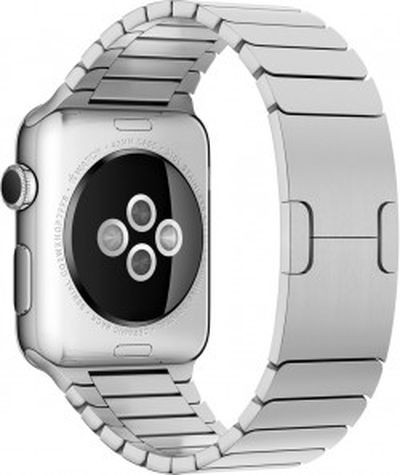
apple_watch_sensorThe U.S. Patent and Trademark Office published an invention today that suggests the next Apple Watch could identify its owner simply by checking their heart rate.

Apple's patent application is titled "User identification system based on plethysmography" and describes how a pulse oximeter is used to determine the biometric signature of a user's cardio rhythms. This data could then be used to identify the wearer and unlock the watch in a manner similar to Touch ID on the iPhone.

The system works similarly to existing monitors, by projecting light on the user's skin and measuring how much of it is absorbed and reflected back to the device. The measurement can then be used to determine the amount of blood present in the vasculature. According to the patent, the data gathered by the two photosensors is either stored or compared against previously saved information to positively identify the user.

In an associated patent also published today, the invention is extended to take in data from motion sensors like accelerometers and gyroscopes to determine user movement. Certain gestures, for example raising the device from waist height to head height, trigger the authentication process.

AppleInsider notes that the system could replace Touch ID during Apple Pay payments and further reduce the watch's reliance on iPhone, although it's unclear if heart rate data can be a unique enough identifier to ensure the same level of security.

Related Roundup: Apple Watch 11
Tag: Patent

Popular Stories

3 4 24 Sport Band Refresh Feature

Sketchy Rumor Claims Apple Watch Series 12 Could Introduce Sensor in Band

Friday July 3, 2026 8:54 am PDT by
The Apple Watch Series 12 could ship with a new health sensor built directly into one of its bands, according to a sketchy rumor from a known leaker. The leaker known as "Kosutami" says the sensor will be injection-molded into a silicone band, and only a silicone band, apparently because Apple has not yet solved how to embed similar hardware in bands made from other materials. No detail was...
watchos 27

Siri AI Comes to Apple Watch in watchOS 27 Beta 3

Monday July 6, 2026 1:24 pm PDT by
With watchOS 27 beta 3, Apple added support for Siri AI and the Siri app, so Apple Watch users can now use the features right from their wrist. Apple said Siri AI would be coming to the watch back when watchOS 27 was first introduced, but the feature wasn't live until now. The Dynamic App Grid that pops up when the Digital Crown is pressed displays the Siri app in the center, and the...
Apple Watch Series 10 Jet Black

Apple Watch Series 13 Rumored to Mark the End of an Era

Wednesday July 8, 2026 1:29 pm PDT by
While the Apple Watch Series 12 is still a few months away, a new rumor suggests that next year's Apple Watch Series 13 will mark the end of an era. According to a recent post from a known leaker on the Chinese social media platform Weibo, the Apple Watch will be receiving a major redesign next year, and this will apparently include a new way of attaching bands to the watch. As a result, the ...

Top Rated Comments

radiology Avatar
128 months ago
this is just NOT possible. Your heart rate can change a lot in many normal and abnormal conditions. I call this BS.
Score: 10 Votes (Like | Disagree)
128 months ago
this is just NOT possible. Your heart rate can change a lot in many normal and abnormal conditions. I call this BS.
What this sensor measures is how you blood vessels expand as a pressure pulse is travelling through your veins when the heart contracts. The blood pressure (and thus the size of the blood vessel) follows a periodic fluctuation not unlike a sine curve. The heart rate is given by only looking at the frequency of that periodic fluctuation. Studying the whole shape of the curve gives you much more information than just looking at the frequency.
Score: 8 Votes (Like | Disagree)
Gasu E. Avatar
128 months ago
http://dsn.sagepub.com/content/11/6/549134.full
http://www.inderscience.com/storage/f104531211967812.pdf
http://file.scirp.org/pdf/JIS20120100004_57389606.pdf
https://www.ncbi.nlm.nih.gov/pmc/articles/PMC4535678/

Is it that your holding off until the security parity between heartbeat signatures and fingerprints is closed, or do you honestly not believe it is a viable identification technique? The way I read you posts you seemed to dispute that heartbeat signatures are unique. Am I misreading your objection?
Troll trap! He's got you doing his research for you! Meanwhile he just sits back and armchair reacts to your posts. Is it so important to get this guy to agree with you that you have to do his work for him, given he's not intellectually curious enough to do it for himself?
Score: 6 Votes (Like | Disagree)
iapplelove Avatar
128 months ago
That's deliciously clever technology. The Star Trek future gets ever closer.
You would be amazed at the technology our secret space programs keep from us. Stuff we already have, things us normal people won't ever get to experience.
Score: 5 Votes (Like | Disagree)
BMcCoy Avatar
128 months ago
No, my objection is that there is no way this currently works when scaled up to a decent population size, which is of course what would be required for this to be an identification technology.

Did you read those papers, or did you just quickly google, then cut n paste?

"..the majority of the studies have been conducted on a small population (about a few tens of subjects). Therefore, the applicability of ECG biometric recognition on a large scale (real life authentication scenario) it is not yet proven."

"..almost all studies (except for [17 ('https://www.ncbi.nlm.nih.gov/pmc/articles/PMC4535678/#CR17')] and [31 ('https://www.ncbi.nlm.nih.gov/pmc/articles/PMC4535678/#CR31')] ) ignored the variability of the ECG during life span (i.e. variability induced by work, ageing, iterate sport activity etc.); moreover, only few studies [57 ('https://www.ncbi.nlm.nih.gov/pmc/articles/PMC4535678/#CR57'), 83 ('https://www.ncbi.nlm.nih.gov/pmc/articles/PMC4535678/#CR83'), 136 ('https://www.ncbi.nlm.nih.gov/pmc/articles/PMC4535678/#CR136')] considered the applicability of these techniques when subjects suffer from pathological conditions. ECG recognition in pathological subjects is another aspect worth of additional investigations."

"it must be emphasised that, while guidelines are available for ECG acquisition in the clinical scenario, there is still a lack of standardisation on ECG acquisition (number of leads and their positioning, sampling frequency, number of bits, filtering, type of electrodes, number of leads etc.) for biometrics applications. However, ECG databases for biometric recognition should ideally include recordings, at a given sampling frequency and conditions, from the same subjects in different circumstances (e.g. relaxed, during and after physical training) and along a period of several years."

And still no discussion of sensitivity and specificity.

Not even remotely close to being a practical and usable technology.
Score: 3 Votes (Like | Disagree)
NT1440 Avatar
128 months ago
Except it's not.
It's nowhere near as individual as a fingerprint.
And fingerprints don't change moment-to-moment depending on your breathing, activity, and environment.

Yeah, something not adding up here...!
You don't understand micro palpitations do you? The way your heart operates doesn't change moment-to-moment.

https://www.wired.com/insights/2014/06/heartbeat-may-soon-password/

"
Yury: I didn’t realize that people’s heartbeats are different. Is the heartbeat really a reliable biometric?

D’Souza: Yes, it is! Everybody’s got a unique heartbeat. It’s based on the size and shape of your heart and the orientation of your valves, your physiology. It doesn’t change unless you have a major cardiac event like a heart attack.

Yury: What about when you’re nervous and your heart rate goes up? Will it still work?

D’Souza: Your heart can beat faster but electrically your beats look the same. So, whether it beats faster or slower, it doesn’t really matter. It’s really about the shape of the waves, and what that signal looks like when it comes off your heart.
"
Score: 3 Votes (Like | Disagree)

🔗 Related Apple News & Rumors

Stay updated with the latest Apple ecosystem news and verified rumors