'AceDeceiver' iOS Trojan Spotted in China, Bypasses Apple's DRM Mechanism

A new iOS trojan has been found in the wild that's able to infect non-jailbroken iOS devices through PCs without the need to exploit an enterprise certificate. Named "AceDeceiver," the malware was discovered by Palo Alto Networks and is currently affecting iOS users in China.

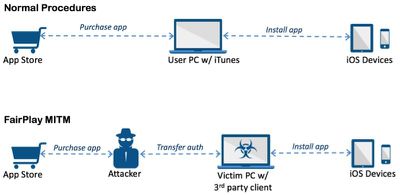
AceDeceiver infects an iOS device by taking advantage of flaws in FairPlay, Apple's digital rights management (DRM) system. According to Palo Alto Networks, it uses a technique called "FairPlay Man-in-the-Middle," which has been used to spread pirated iOS apps in the past by using fake iTunes software and spoofed authorization codes to get the apps on iOS devices. The same technique is now being used to spread the AceDeceiver malware.
acedeceiverfairplaymitm

Apple allows users purchase and download iOS apps from their App Store through the iTunes client running in their computer. They then can use the computers to install the apps onto their iOS devices. iOS devices will request an authorization code for each app installed to prove the app was actually purchased. In the FairPlay MITM attack, attackers purchase an app from App Store then intercept and save the authorization code.

They then developed PC software that simulates the iTunes client behaviors, and tricks iOS devices to believe the app was purchased by victim. Therefore, the user can install apps they never actually paid for, and the creator of the software can install potentially malicious apps without the user's knowledge.

From July of 2015 to February of 2016, three AceDeceiver iOS apps were uploaded to the official iOS App Store, posing as wallpaper apps and providing attackers with a fake authorization code to use in the AceDeceiver attacks.

A Windows iPhone management app called "Aisi Helper" that claimed to provide services like system backup and cleaning was installed by users in China, and it went on to install malicious iOS apps on connected devices. The apps were designed to be third-party App Stores with free content to bait users into using them and submitting their Apple IDs and passwords. Apple ID information was then uploaded to the AceDeceiver server.

Though Apple removed the original AceDeceiver iOS apps from the App Store in February (the ones used by the hackers to obtain the authorization codes), the attack remains active because attackers still have the authorization codes necessary to install fake apps on iOS devices. AceDeceiver only affects users in China, but Palo Alto Networks believes the AceDeceiver trojan or similar malware could spread to additional regions in the future. AceDeceiver is especially insidious as it has not been patched (and could work on older versions of iOS even when patched), installs apps automatically from an infected computer, and does not require an enterprise certificate.

acedeceiveriosapp

An AceDeceiver third-party App Store app installed automatically on an iOS device through a computer using the Aisi Helper Malware

AceDeceiver in its current incarnation requires users to download the Aisi Helper Windows app to their computers before the malware can spread to iOS devices, so people who have downloaded this software should remove it immediately and change their Apple ID passwords. In the future, AceDeceiver can be avoided by not downloading suspicious software.

Palo Alto Networks has a full rundown of AceDeceiver, its history, and how it works on the Palo Alto Networks website. It's well worth reading for anyone who wants more information about the malware.

Popular Stories

Aston Martin CarPlay Ultra Screen

Apple's CarPlay Ultra to Expand to These Vehicle Brands Later This Year

Sunday February 1, 2026 10:08 am PST by
Last year, Apple launched CarPlay Ultra, the long-awaited next-generation version of its CarPlay software system for vehicles. Nearly nine months later, CarPlay Ultra is still limited to Aston Martin's latest luxury vehicles, but that should change fairly soon. In May 2025, Apple said many other vehicle brands planned to offer CarPlay Ultra, including Hyundai, Kia, and Genesis. In his Powe...
Apple Logo Black

Apple Just Made Its Second-Biggest Acquisition Ever After Beats

Thursday January 29, 2026 10:07 am PST by
Apple today confirmed to Reuters that it has acquired Q.ai, an Israeli startup that is working on artificial intelligence technology for audio. Apple paid close to $2 billion for Q.ai, according to sources cited by the Financial Times. That would make this Apple's second-biggest acquisition ever, after it paid $3 billion for the popular headphone and audio brand Beats in 2014. Q.ai has...
Apple Logo Black

Apple's Next Launch is 'Imminent'

Sunday February 1, 2026 12:31 pm PST by
The calendar has turned to February, and a new report indicates that Apple's next product launch is "imminent," in the form of new MacBook Pro models. "All signs point to an imminent launch of next-generation MacBook Pros that retain the current form factor but deliver faster chips," Bloomberg's Mark Gurman said on Sunday. "I'm told the new models — code-named J714 and J716 — are slated...
14 inch MacBook Pro Keyboard

Apple Changes How You Order a Mac

Saturday January 31, 2026 10:51 am PST by
Apple recently updated its online store with a new ordering process for Macs, including the MacBook Air, MacBook Pro, iMac, Mac mini, Mac Studio, and Mac Pro. There used to be a handful of standard configurations available for each Mac, but now you must configure a Mac entirely from scratch on a feature-by-feature basis. In other words, ordering a new Mac now works much like ordering an...
Apple MacBook Pro M4 hero

New MacBook Pros Reportedly Launching Alongside macOS 26.3

Sunday February 1, 2026 5:42 am PST by
Apple is planning to launch new MacBook Pro models with M5 Pro and M5 Max chips alongside macOS 26.3, according to Bloomberg's Mark Gurman. "Apple's faster MacBook Pros are planned for the macOS 26.3 release cycle," wrote Gurman, in his Power On newsletter today. "I'm told the new models — code-named J714 and J716 — are slated for the macOS 26.3 software cycle, which runs from...

Top Rated Comments

OldSchoolMacGuy Avatar
129 months ago
Installing software from a questionable source and get hacked? No way!
Score: 18 Votes (Like | Disagree)
macintoshmac Avatar
129 months ago
"Though Apple removed the apps from the App Store in February, the attack remains active because attackers still have the authorization code,"

This. This is why Apple should never bow down to the FBI in the first place, and make sure that FBI knows this that nothing is secure in this world except content in a person's head. And philosophically, Alzheimer's is one of the the virus/ malware/ trojans that can wreck havoc to that data as well, making nothing at all truly completely secure and safe.

Apple can remove the GovernmentOS but the code once created can and most likely will be out in the wild very soon. That is a risk that nobody should take.
Score: 10 Votes (Like | Disagree)
hfletcher Avatar
129 months ago
So in order for iOS to be infected, you need to install a 'fake' iTunes to begin with?
Score: 10 Votes (Like | Disagree)
Norbs12 Avatar
129 months ago
What do you expect... you do shady sh*t without fully understanding it, shady sh*t happens to you.
Score: 8 Votes (Like | Disagree)
ForkHandles Avatar
129 months ago
Good old China. Can't create or do anything productive so they have to hack others. They really are one of the worst countries on the planet.
Did you really just say that China makes nothing? Since they seem to make everything , what did you mean?
Score: 8 Votes (Like | Disagree)
Sirious Avatar
129 months ago
Is iOS getting weaker by the day?


Attachment Image
Score: 8 Votes (Like | Disagree)