Apple Interested in Liquidmetal Alloys for Home Buttons, Touch Sensors, and Tamper-Resistant Screws

Back in 2010, Apple signed an exclusive agreement with Caltech spinoff Liquidmetal Technologies, providing Apple with the rights to use Liquidmetal's advanced metal alloys for consumer electronics purposes. Liquidmetal's amorphous metal alloys or bulk metallic glasses posses a number of characteristic properties such as high strength and corrosion resistance while remaining relatively light and able to be cast into a variety of forms.

Apple quietly tested Liquidmetal's alloys in the SIM card eject tool for the iPhone 3G, but the materials have otherwise not been confirmed to have appeared in any other Apple products, as one of alloys' inventors noted in 2012 that their use as major design materials was still several years in the future.

Evidence of Apple's continued interest with Liquidmetal alloys has surfaced a number of times over the past several years, including in a granted patent from July covering a process for mass producing thin sheets of the Liquidmetal alloys and a series of technical patent applications published in November describing methods of working with the alloys to create products.

A number of patent applications addressing additional innovations with Liquidmetal alloys have been published since that time, including a batch of 17 applications published just this past Thursday. Many of these applications are not yet listed as being assigned to Apple, but the inventors listed on the patents are Apple employees who have routinely been associated with the company's work on Liquidmetal alloys in the past.

One of these patent applications proposes using Liquidmetal alloys in pressure sensors such as those found in buttons and switches on mobile devices, offering greater durability under repeated use. Figures accompanying the patent application closely resemble the iconic home button found on Apple's iOS devices.

Because switches on consumer electronic devices are operated frequently, the materials used to fabricate the switch must be capable of repeated deformation and return to their original configuration. The ability of a material to deform reversibly under stress is known as the material's elasticity. Above a certain stress, known as the elastic limit of a material or the yield strength, the metal material may deform irreversibly, becoming inelastic, exhibiting plasticity and adversely affecting the function and utility of the switch. [...]

A proposed solution according to embodiments herein for pressure sensors is to use bulk-solidifying amorphous alloys as the deformable material, and to measure the pressure based on the physical changes of the bulk-solidifying amorphous alloy as it is deformed.
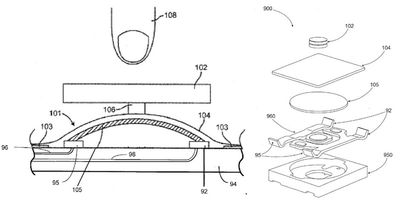
liquidmetal_button

Button or switch using Liquidmetal alloy as deformable material

Another application published in mid-December describes how Liquidmetal alloys could be used as material for tamper-resistant screws to help secure devices against unauthorized access.

A proposed solution according to embodiments herein for tamper resistance is a fastener having a head portion and a tamper resistant bulk-solidifying amorphous alloy interlock portion, wherein the fastener and the substrate into which the fastener is fitted into are permanently fastened via an interlock formed from the interlock portion during the fastening process.
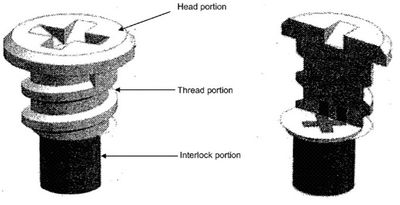
liquidmetal_screw

Tamper-resistant screw made of Liquidmetal alloys

A third patent application addresses the use of Liquidmetal alloys as a substrate for touch sensors found in displays such as in Apple's iOS devices. Apple describes how discrete areas of crystallinity can be created on the amorphous metal substrate, allowing for greater control and higher density of touch sensing arrays, thus giving greater positional precision for touch sensing.
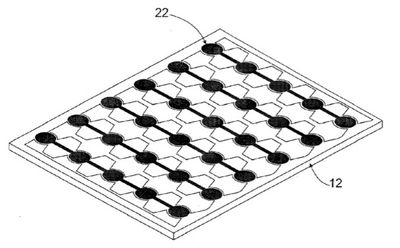
liquidmetal_touch_sensor

Touch sensor grid using Liquidmetal alloy as substrate

Most of the remaining patents are more technical in nature, addressing methods for working with Liquidmetal alloys or assessing their characteristics. One such patent application does, however, address methods for applying or transforming coatings to an amorphous material, allowing for increased durability and strength by protecting the underlying metal.

All of these patent applications were filed in June or July of 2012, suggesting that Apple may have made significant progress on these disclosed inventions since that time. It is unclear, however, whether any of the techniques or proposed components have made their way into shipping products or if they remain in the research or prototyping phase.

(Thanks, David!)

Tag: Patent

Popular Stories

Aston Martin CarPlay Ultra Screen

Apple's CarPlay Ultra to Expand to These Vehicle Brands Later This Year

Sunday February 1, 2026 10:08 am PST by
Last year, Apple launched CarPlay Ultra, the long-awaited next-generation version of its CarPlay software system for vehicles. Nearly nine months later, CarPlay Ultra is still limited to Aston Martin's latest luxury vehicles, but that should change fairly soon. In May 2025, Apple said many other vehicle brands planned to offer CarPlay Ultra, including Hyundai, Kia, and Genesis. In his Powe...
Apple Logo Black

Apple Just Made Its Second-Biggest Acquisition Ever After Beats

Thursday January 29, 2026 10:07 am PST by
Apple today confirmed to Reuters that it has acquired Q.ai, an Israeli startup that is working on artificial intelligence technology for audio. Apple paid close to $2 billion for Q.ai, according to sources cited by the Financial Times. That would make this Apple's second-biggest acquisition ever, after it paid $3 billion for the popular headphone and audio brand Beats in 2014. Q.ai has...
Apple Logo Black

Apple's Next Launch is 'Imminent'

Sunday February 1, 2026 12:31 pm PST by
The calendar has turned to February, and a new report indicates that Apple's next product launch is "imminent," in the form of new MacBook Pro models. "All signs point to an imminent launch of next-generation MacBook Pros that retain the current form factor but deliver faster chips," Bloomberg's Mark Gurman said on Sunday. "I'm told the new models — code-named J714 and J716 — are slated...
14 inch MacBook Pro Keyboard

Apple Changes How You Order a Mac

Saturday January 31, 2026 10:51 am PST by
Apple recently updated its online store with a new ordering process for Macs, including the MacBook Air, MacBook Pro, iMac, Mac mini, Mac Studio, and Mac Pro. There used to be a handful of standard configurations available for each Mac, but now you must configure a Mac entirely from scratch on a feature-by-feature basis. In other words, ordering a new Mac now works much like ordering an...
Apple MacBook Pro M4 hero

New MacBook Pros Reportedly Launching Alongside macOS 26.3

Sunday February 1, 2026 5:42 am PST by
Apple is planning to launch new MacBook Pro models with M5 Pro and M5 Max chips alongside macOS 26.3, according to Bloomberg's Mark Gurman. "Apple's faster MacBook Pros are planned for the macOS 26.3 release cycle," wrote Gurman, in his Power On newsletter today. "I'm told the new models — code-named J714 and J716 — are slated for the macOS 26.3 software cycle, which runs from...

Top Rated Comments

ouimetnick Avatar
157 months ago
I hope those tamper resistant screws don't ever appear in any Apple product.
Score: 20 Votes (Like | Disagree)
anubis Avatar
157 months ago
Right. Thanks for clarifying.

Any idea how the heck interlock screws are supposed to be removed? How does apple service these devices?

I think the point is that with the tamper resistant screws, you DON'T service them. Neither does Apple. The device is permanently sealed and if you need to repair the device, you throw the device away and get a new one.

I think out of all of the patents in this story, the tamper resistant screw should set off the most alarm bells.
Score: 18 Votes (Like | Disagree)
goobot Avatar
157 months ago
I remember how the SIM Card tray was liquidmetal on the 3G. For whatever reason.

Sim card tray remover was liquid metal. Pretty sure the tray was plastic.
Score: 10 Votes (Like | Disagree)
KazKam Avatar
157 months ago
I think the point is that with the tamper resistant screws, you DON'T service them. Neither does Apple. The device is permanently sealed and if you need to repair the device, you throw the device away and get a new one.

I think out of all of the patents in this story, the tamper resistant screw should set off the most alarm bells.

I'm confused by the method of tamper resistant screw outlined here too, but I don't think this means it's not serviceable as you suggest. Tamper resistant means just that... not to be tampered with, casually. If the point is for it not to be serviceable at all, why even use a fastener with a head? Why not a rivet or a weld?
Score: 8 Votes (Like | Disagree)
unagimiyagi Avatar
157 months ago
Are you saying my wife should push my home button less to make me more responsive?

----------


To all concerned about the temper resistant screws:

If it is made by humans it can be solved by humans.

So, no matter what these screws will be defeated by us.

Worst case we re-drill and put in another kind of screw or we'll check the 526,917 possibilities on You Tube.
Not to worry. Anybody who tinkers will not be distraught by this.

You're right--the tamper resistant screws can be defeated (how I don't know, just going by precedent). But the real question is how the tamper resistant screws enable apple to make even more money, which is what they care about. This fanatical control has got to stop and the question has to be asked, why support these types of practices at all as consumers? Answer: only if apple's products are just that much better to be worth all of this control and premium pricing. The answer for me is becoming "no, it's just worth all of this" anymore. When I look back, my iphones have been no more durable, or even less durable than my android phones. The manufacturing is all pretty much even now, except that I've paid twice as much for my phones and even had them serviced. $260 to replace a power button that has been the target of class action lawsuits already? Please. I could just buy a new phone at that price. Oh wait, that's what Apple store told me I had to do in order to fix a broken power button whose cause is the very definition of a manufacturer defect.
Score: 6 Votes (Like | Disagree)
ElTorro Avatar
157 months ago
Temper resistant screws = one more level of control and a way to make it impossible to repair the products.
I hope they won't start putting them into the macs.
Score: 4 Votes (Like | Disagree)