Apple's Smart Watch May Not Launch Until Late 2014, Use Biometrics and iPod Nano Technology
KGI Securities analyst Ming-Chi Kuo, who has on a number of occasions offered accurate information about Apple's product plans, issued a new research report this week outlining his expectations for Apple's rumored smart watch device, informally dubbed "iWatch". Despite some expectations that the device could launch later this year, Kuo believes that both hardware and software issues will result in the iWatch making its debut in the second half of 2014.
Apple may not have adequate resources to develop an iWatch version of iOS because it may require big changes to iPhone and iPad iOS this year. In addition, wearable device components aren’t mature. For these reasons, we think mass production of the iWatch is more likely to begin in 2H14, not 2H13 as the market speculates.
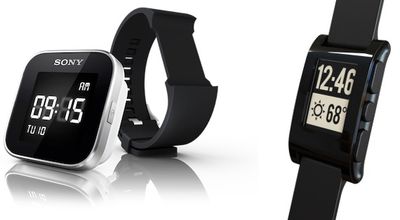
Sony SmartWatch (left) and Pebble e-paper watch (right)
On the hardware front, Kuo projects that the iWatch will use a 1.5-2.0 inch display and unsurprisingly believes that Apple will draw on the iPod nano when it comes to components, particularly with respect to the main processor and the touch technology.
Currently, the iPod nano uses the same GF2 touch technology as used by the iPad mini. Since the size and computing ability requirements of the iWatch are similar to those of the iPod nano, we think iWatch will use iPod nano’s GF2 touch technology and AP [application processor].
Further, Kuo believes that biometrics will be a key feature for the iWatch, allowing for increased security and opening the door to broader health-related applications. The biometric support should also aid in building out the cross-device integration many expect to see from the iWatch.
Rumors regarding Apple's smart watch project have been relatively quiet over the past few months, although a report from earlier this week claimed that Apple is testing 1.5-inch OLED displays for the device, with Foxconn said to be gearing up for a trial run of 1,000 devices.
Popular Stories
Last year, Apple launched CarPlay Ultra, the long-awaited next-generation version of its CarPlay software system for vehicles. Nearly nine months later, CarPlay Ultra is still limited to Aston Martin's latest luxury vehicles, but that should change fairly soon.
In May 2025, Apple said many other vehicle brands planned to offer CarPlay Ultra, including Hyundai, Kia, and Genesis.
In his Powe...
The calendar has turned to February, and a new report indicates that Apple's next product launch is "imminent," in the form of new MacBook Pro models.
"All signs point to an imminent launch of next-generation MacBook Pros that retain the current form factor but deliver faster chips," Bloomberg's Mark Gurman said on Sunday. "I'm told the new models — code-named J714 and J716 — are slated...
We are still waiting for the iOS 26.3 Release Candidate to come out, so the first iOS 26.4 beta is likely still at least a week or two away. Following beta testing, iOS 26.4 will likely be released to the general public in March or April.
Below, we have recapped known or rumored iOS 26.3 and iOS 26.4 features so far.
iOS 26.3
iPhone to Android Transfer Tool
iOS 26.3 makes it easier...
Apple is planning to launch new MacBook Pro models with M5 Pro and M5 Max chips alongside macOS 26.3, according to Bloomberg's Mark Gurman.
"Apple's faster MacBook Pros are planned for the macOS 26.3 release cycle," wrote Gurman, in his Power On newsletter today.
"I'm told the new models — code-named J714 and J716 — are slated for the macOS 26.3 software cycle, which runs from...
In 2022, Apple introduced a new Apple Home architecture that is "more reliable and efficient," and the deadline to upgrade and avoid issues is fast approaching.
In an email this week, Apple gave customers a final reminder to upgrade their Home app by February 10, 2026. Apple says users who do not upgrade may experience issues with accessories and automations, or lose access to their smart...