Tweaked Apple TV Offers 'Significant' but Nearly Invisible Power Savings With More Efficient Chip Designs
Following Chipworks' examination of the new A5 chip found in Apple's tweaked Apple TV, AnandTech has performed its own analysis of the device. While many of the A5 chip details have already been covered, AnandTech focuses more on the device as a whole, and interestingly finds that the internal changes have yielded a significant decrease in power consumption compared to its predecessor.
The power savings are nothing short of significant. The previous generation Apple TV wasn’t really a power hog, with platform power maxing out at around 1.6W, but the new model tops out at just a watt. Overall the power savings seem to be around 800mW across the board.
With no change to process technology, I can only assume that the reduction in power consumption came from other architectural or silicon optimizations.
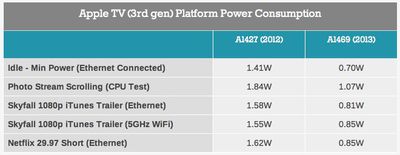
Of course, AnandTech also notes that the power savings are essentially invisible to users given how little power the set-top box used to begin with.
Assuming you’re using the Apple TV for watching video 8 hours a day, every day of the year, you’d save about $0.26 per year on your power bill (assuming $0.11/kWh). You’d break even on the $99 cost of a new Apple TV in about 385 years. Maybe by then we’ll actually have a true replacement to cable TV.
AnandTech also measured Wi-Fi performance on the tweaked Apple TV given that Apple has moved to a new Broadcom Wi-Fi chip and gone back to a one-antenna layout from the two-antenna configuration used in the previous model. Testing revealed that Wi-Fi range and performance is essentially identical between the old and new hardware.
Apple's reasons for introducing a brand-new chip design for the relatively low-volume Apple TV remain unclear, with AnandTech summarizing some of the recent speculation that Apple may be trying to shave costs by stripping out unnecessary components of the A5 or testing the new chip ahead of a broader rollout in other products.
Popular Stories
Last year, Apple launched CarPlay Ultra, the long-awaited next-generation version of its CarPlay software system for vehicles. Nearly nine months later, CarPlay Ultra is still limited to Aston Martin's latest luxury vehicles, but that should change fairly soon.
In May 2025, Apple said many other vehicle brands planned to offer CarPlay Ultra, including Hyundai, Kia, and Genesis.
In his Powe...
The calendar has turned to February, and a new report indicates that Apple's next product launch is "imminent," in the form of new MacBook Pro models.
"All signs point to an imminent launch of next-generation MacBook Pros that retain the current form factor but deliver faster chips," Bloomberg's Mark Gurman said on Sunday. "I'm told the new models — code-named J714 and J716 — are slated...
We are still waiting for the iOS 26.3 Release Candidate to come out, so the first iOS 26.4 beta is likely still at least a week or two away. Following beta testing, iOS 26.4 will likely be released to the general public in March or April.
Below, we have recapped known or rumored iOS 26.3 and iOS 26.4 features so far.
iOS 26.3
iPhone to Android Transfer Tool
iOS 26.3 makes it easier...
Apple is planning to launch new MacBook Pro models with M5 Pro and M5 Max chips alongside macOS 26.3, according to Bloomberg's Mark Gurman.
"Apple's faster MacBook Pros are planned for the macOS 26.3 release cycle," wrote Gurman, in his Power On newsletter today.
"I'm told the new models — code-named J714 and J716 — are slated for the macOS 26.3 software cycle, which runs from...
In 2022, Apple introduced a new Apple Home architecture that is "more reliable and efficient," and the deadline to upgrade and avoid issues is fast approaching.
In an email this week, Apple gave customers a final reminder to upgrade their Home app by February 10, 2026. Apple says users who do not upgrade may experience issues with accessories and automations, or lose access to their smart...