Apple's 'Unbreakable' iOS Device Encryption Highlighted

apple security iconTechnology Review takes a look at the evolution of security on the iPhone, noting how Apple has been able to gain acceptance in government and enterprise by overcoming its initially lax stance on device security to roll out industry-leading encryption options that can defeat essentially all attempts at accessing properly protected devices.

At the heart of Apple's security architecture is the Advanced Encryption Standard algorithm (AES), a data-scrambling system published in 1998 and adopted as a U.S. government standard in 2001. After more than a decade of exhaustive analysis, AES is widely regarded as unbreakable. The algorithm is so strong that no computer imaginable for the foreseeable future—even a quantum computer—would be able to crack a truly random 256-bit AES key. The National Security Agency has approved AES-256 for storing top-secret data.

As Apple highlights in a recent white paper (PDF) on iOS security, this hardware security involves the incorporation of a unique AES-256 key fused into each iOS device and which can not be directly read.

Access to the device's software can be restricted with a PIN passcode, and while the default passcode option for iOS is a four-digit number, users can opt to use significantly longer and more complex passcodes. And with brute-force attacks required to break iOS passcodes needing to be run on the device itself at a speed of 80 milliseconds per attempt, a device with an eight-digit passcode could take up to 15 years to compromise.

"There are a lot of issues when it comes to extracting data from iOS devices," says Amber Schroader, CEO of Paraben, a supplier of forensic software, hardware, and services for cell phones. "We have had many civil cases we have not been able to process ... for discovery because of encryption blocking us."

Most of the information included in this report is not particularly new, and Apple's white paper goes into more detail on the company's efforts to address security on iOS devices, but the report offers an overview of the layers of security Apple has built into its products.
Popular Stories

Aston Martin CarPlay Ultra Screen

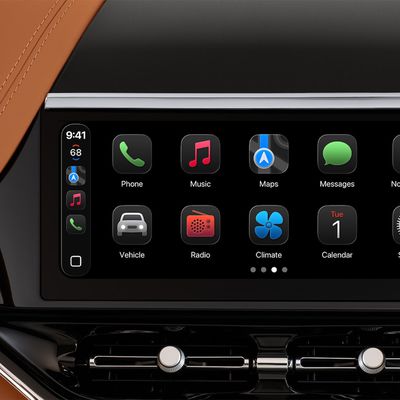
Apple's CarPlay Ultra to Expand to These Vehicle Brands Later This Year

Sunday February 1, 2026 10:08 am PST by
Last year, Apple launched CarPlay Ultra, the long-awaited next-generation version of its CarPlay software system for vehicles. Nearly nine months later, CarPlay Ultra is still limited to Aston Martin's latest luxury vehicles, but that should change fairly soon. In May 2025, Apple said many other vehicle brands planned to offer CarPlay Ultra, including Hyundai, Kia, and Genesis. In his Powe...
Apple Logo Black

Apple's Next Launch is 'Imminent'

Sunday February 1, 2026 12:31 pm PST by
The calendar has turned to February, and a new report indicates that Apple's next product launch is "imminent," in the form of new MacBook Pro models. "All signs point to an imminent launch of next-generation MacBook Pros that retain the current form factor but deliver faster chips," Bloomberg's Mark Gurman said on Sunday. "I'm told the new models — code-named J714 and J716 — are slated...
iOS 26

iOS 26.3 and iOS 26.4 Will Add These New Features to Your iPhone

Tuesday February 3, 2026 7:47 am PST by
We are still waiting for the iOS 26.3 Release Candidate to come out, so the first iOS 26.4 beta is likely still at least a week or two away. Following beta testing, iOS 26.4 will likely be released to the general public in March or April. Below, we have recapped known or rumored iOS 26.3 and iOS 26.4 features so far. iOS 26.3 iPhone to Android Transfer Tool iOS 26.3 makes it easier...
Apple MacBook Pro M4 hero

New MacBook Pros Reportedly Launching Alongside macOS 26.3

Sunday February 1, 2026 5:42 am PST by
Apple is planning to launch new MacBook Pro models with M5 Pro and M5 Max chips alongside macOS 26.3, according to Bloomberg's Mark Gurman. "Apple's faster MacBook Pros are planned for the macOS 26.3 release cycle," wrote Gurman, in his Power On newsletter today. "I'm told the new models — code-named J714 and J716 — are slated for the macOS 26.3 software cycle, which runs from...
iOS 26 Home Feature

Apple Gives Final Warning to Home App Users

Tuesday February 3, 2026 8:55 am PST by
In 2022, Apple introduced a new Apple Home architecture that is "more reliable and efficient," and the deadline to upgrade and avoid issues is fast approaching. In an email this week, Apple gave customers a final reminder to upgrade their Home app by February 10, 2026. Apple says users who do not upgrade may experience issues with accessories and automations, or lose access to their smart...

Top Rated Comments

chainprayer Avatar
176 months ago
Will Apple phone tech support tell you your key if you give them your home address and last 4 digits of your credit card number?
Score: 44 Votes (Like | Disagree)
BC2009 Avatar
176 months ago
So the best approach would be to hack the user instead of the device...
*Phone Rings*

Hi this is Tom calling from Apple. We noticed some recent activity on your iTunes account potentially originating from your iPhone and we need your iPhone device passcode to verify whether or not these charges for $45,912 are fraudulent so we can refund your money.

...
Score: 14 Votes (Like | Disagree)
KnightWRX Avatar
176 months ago
Security works in layers. Implementing a layer is as important as implementing the whole. People saying this is useless are only looking at it at the layer level.

Sure the passkey can be gotten from social engineering. However, this is not what this layer of security protects. This protects someone from accessing what is on the NAND memory if they have physical access to the device itself, but not the user (stolen/lost iPhone). This is a requirement for enterprises as they do not want their secrets to fall into the wrong hands.

As such, Blackberries were highly regarded.
Score: 8 Votes (Like | Disagree)
Zunjine Avatar
176 months ago
Not to be picky.

"Not to be picky" is as certain the preceed pickiness as "with all due respect" is certain to forshadow an utter lack thereof.
Score: 8 Votes (Like | Disagree)
Bezetos Avatar
176 months ago
Big deal. Most smartphones use encryption.

Moreover:

(...) a device with an eight-digit passcode could take up to 15 years to compromise.
That's not true.

Direct quote from Apple's white paper (http://images.apple.com/ipad/business/docs/iOS_Security_May12.pdf):
The iteration count is calibrated so that one attempt takes approximately 80 milliseconds. This means it would take more than 5½ years to try all combinations of a six-character alphanumeric passcode with lowercase letters and numbers, or 2½ years for a nine-digit passcode with numbers only.

An eight-digit passcode would "only" take 92 days to compromise. A four-digit passcode (from my experience the most popular one) would only take 13 minutes to compromise.
Score: 7 Votes (Like | Disagree)
gjwfoasfsaevg Avatar
176 months ago
So Apple is using AES. Big deal. Most systems are not cracked by breaking the encryption algorithm, but by exploiting weaknesses in key management. XBOX, PS3, Bluray, iCloud, FileVault are notable examples where the best encryption algorithm in the world wouldn't have changed anything.
Score: 7 Votes (Like | Disagree)