Sony Introduces Next-Generation Image Sensor to Advance Mobile Device Cameras

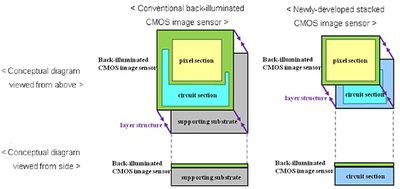
Sony today announced (via Macworld UK) the launch of new image sensor technology that the company expects will help improve performance and shrink the size of cameras on mobile devices by later this year. The new back-illuminated complementary metal–oxide–semiconductor (CMOS) image sensor utilizes a pixel section layered directly onto the sensor's circuitry, significantly reducing the sensor size from the previous design that utilized pixel and circuit sections side-by-side on a substrate layer.

This image sensor layers the pixel section containing formations of back-illuminated structure pixels onto chips containing the circuit section for signal processing, which is in place of supporting substrates for conventional back-illuminated CMOS image sensors. This structure achieves further enhancement in image quality, superior functionalities and a more compact size that will lead to enhanced camera evolution.

With sampling set to begin in March, the new stacked CMOS sensor includes built-in signal processing technology and utilizes the company's "RGBW Coding" that adds white-light sensors to the traditional red, green and blue, offering better low-light camera performance. Enhanced high dynamic range (HDR) technology will also improve the sensor's movie capabilities in bright-light situations.
sony 2012 cmos image sensor
Apple had utilized OmniVision Technologies as its image sensor supplier on its mobile devices, but Sony was able attract at least part of Apple's business with the new 8-megapixel sensor on the iPhone 4S. With its new image sensor technology, which is set to enter mass production in the fall and begin appearing in products late this year or early next year, Sony is clearly looking to remain at the forefront of the booming mobile device camera market.

Popular Stories

iOS 26

iOS 26.3 and iOS 26.4 Will Add These New Features to Your iPhone

Tuesday February 3, 2026 7:47 am PST by
We are still waiting for the iOS 26.3 Release Candidate to come out, so the first iOS 26.4 beta is likely still at least a week or two away. Following beta testing, iOS 26.4 will likely be released to the general public in March or April. Below, we have recapped known or rumored iOS 26.3 and iOS 26.4 features so far. iOS 26.3 iPhone to Android Transfer Tool iOS 26.3 makes it easier...
Aston Martin CarPlay Ultra Screen

Apple's CarPlay Ultra to Expand to These Vehicle Brands Later This Year

Sunday February 1, 2026 10:08 am PST by
Last year, Apple launched CarPlay Ultra, the long-awaited next-generation version of its CarPlay software system for vehicles. Nearly nine months later, CarPlay Ultra is still limited to Aston Martin's latest luxury vehicles, but that should change fairly soon. In May 2025, Apple said many other vehicle brands planned to offer CarPlay Ultra, including Hyundai, Kia, and Genesis. In his Powe...
Apple Logo Black

Apple's Next Launch is 'Imminent'

Sunday February 1, 2026 12:31 pm PST by
The calendar has turned to February, and a new report indicates that Apple's next product launch is "imminent," in the form of new MacBook Pro models. "All signs point to an imminent launch of next-generation MacBook Pros that retain the current form factor but deliver faster chips," Bloomberg's Mark Gurman said on Sunday. "I'm told the new models — code-named J714 and J716 — are slated...
Apple MacBook Pro M4 hero

New MacBook Pros Reportedly Launching Alongside macOS 26.3

Sunday February 1, 2026 5:42 am PST by
Apple is planning to launch new MacBook Pro models with M5 Pro and M5 Max chips alongside macOS 26.3, according to Bloomberg's Mark Gurman. "Apple's faster MacBook Pros are planned for the macOS 26.3 release cycle," wrote Gurman, in his Power On newsletter today. "I'm told the new models — code-named J714 and J716 — are slated for the macOS 26.3 software cycle, which runs from...
iOS 26 Home Feature

Apple Gives Final Warning to Home App Users

Tuesday February 3, 2026 8:55 am PST by
In 2022, Apple introduced a new Apple Home architecture that is "more reliable and efficient," and the deadline to upgrade and avoid issues is fast approaching. In an email this week, Apple gave customers a final reminder to upgrade their Home app by February 10, 2026. Apple says users who do not upgrade may experience issues with accessories and automations, or lose access to their smart...


Top Rated Comments

Gasu E. Avatar
183 months ago
Beat you by 8 minutes. https://forums.macrumors.com/showthread.php?p=14204994

I'm trying to imagine why someone would post this.
Score: 9 Votes (Like | Disagree)
knewsom Avatar
183 months ago
The trouble with this technology is, what exactly will they do with it?

1. More megapixels

We all know that more mexapixels do not mean better photos. The iPhone 4's camera was better than anything else on the market, even though it shot with less resolution. Optics and sensor size have a lot to do with image quality, whereas resolution actually has quite little to do with it, once you get above the 5 mp range. In truth, I sometimes wonder if my iPhone 4 took better pictures than my 4S.

2. Smaller cameras

Smaller cameras do not take better pictures. LARGER cameras take better pictures. The bigger the sensor, the bigger the lens, generally speaking, the better your picture will be. I realize this is a gross oversimplification, but flat depth-of-field free images do not look natural, because our eyes do not work that way. In nature, the animals with the best eyesight (especially at night) tend to have larger eyes. Making the camera smaller in the iPhone is not going to make it take better pictures. ...much the opposite.

3. Combine the two, sell more phones

Of course when combined - smaller phone form-factor and more megapixels, on paper, this will be very attractive for consumers. "Whoah! 13 megapixels!! Look how small it is! HAZ TO HAV!"


The end result is no improvement whatsoever, unless they keep sensor size the same, or increase it - which I don't see happening. Making smaller things is cheaper. It's difficult to sell image quality because most people can't tell the difference.
Score: 7 Votes (Like | Disagree)
knewsom Avatar
183 months ago
More megapixels don't help if the rest of the camera system aren't up to it. However more pixels can be extremely useful if you maintain image quality. Note that this implies that pixels don't directly impact image quality, however in the long run you are far better off having the extra pixels to work with.

[...]the ability of a camera to resolve detail is very important. This is as much an issue of optics as it is sensor technology. However the more quality information you have to work with the better your pictures and the greater your flexibility with post processing.
I never said more megapixels can't ever be beneficial - sure they can, and and I welcome them if the rest of the camera is up to snuff... but really, how many manufacturers make optics and processing that actually keep pace with their sensor resolution? Most don't. Apple has been pretty good about this, but as I said before, don't take ANYTHING for granted.

Larger cameras and there for larger optics do not assure you of higher quality. The fact of the matter is the larger the optics the harder it is to control aberrations and other issues that impact rendered images.

Bigger sensors can capture more light but that is only part of the equation. You still need a lens system that can resolve properly to take advantage of the sensors resolution.

The lack of depth of field is a problem at the extreme short focal lengths of common digital cameras.
Of course size is not an assurance of quality, and you need a whole system that can resolve an image in its entirety - that's a given. There are plenty of crappy big cameras out there as well as small ones. ...but a good larger format camera is far better than a good smaler format one. There's a reason pro photographers use full-size CCDs and CMOS sensors instead of micro four thirds.

Also, the larger the optics, the EASIER it is to control aberrations - a speck of dust on a medium format lens vs a speck of dusk on your iphone lens. Which camera has more of its image-acquiring apparatus covered by the same sized speck?

Baloney, some of the best eyes out there are on birds.
Glad you brought that up. Here's a picture of an Osprey skull.

sony introduces next generation image sensor to advance mobile device cameras image

Here's a picture of a horse skull.

sony introduces next generation image sensor to advance mobile device cameras image

Horses are so much larger that their eyes are about the size of an osprey's head, but look how much of an osprey's head is taken up by its eye orbits - they're about as big as they can be on that little head. Clearly, size matters. If you doubt that, especially for low-light, ask an owl.

What is notable is that Apple has been able to avoid that marketing nonsense as they have dramatically improved the iPhones camera. Pixel count is a factor in those improvements, Apple just puts equal weight on other factors when integrating a camera. Call it balanced engineering if you will. As long as they continue to improve over all performance increasing pixels counts is a win.

Actually manufactures are continual linty improving what a small sensor can do. You angst is mis placed as Apple has improved the camera with every iPhone release, and likely will continue to do so. Also contrary to your statement Apple is directly selling the image quality of the iPhone as it has been highlighted many times in marketing materials.

In any event there is lots of upside potential in cell phone camera sensor technology. Very soon we should be seeing sensors built around quantipum dot technologies or other advancements that could easily double low light performance. Other technologies are also being developed to improve cell phone cameras. I suspect that your bigger is better bias isn't based on sound evaluation of the current state of the hardware nor where tech is going.

Think about this, if bigger was indeed better then how is that Apple has improved the camera in every iPhone release?
Sure, Apple has been pretty good about improving camera quality - but I'm not so sure the 4S is a better camera than the 4, in spite of a better lens and more megapixels. Also note that the iPhone's camera has remained about the same size. We should also know that Apple isn't afraid to take a different direction with things. I hope that they will use technology like this as motivation to improve the entire camera - but we really have no idea if they actually will.

My "bigger is better" philosophy with cameras comes from physics, and years of photographic experience and education.
Score: 3 Votes (Like | Disagree)
osx11 Avatar
183 months ago
Why do we ALWAYS get guys asking who needs an improvement? jesus man.

a better camera is a better camera.
Yes: A better camera equals a better phone

However, more megapixels DOES NOT (Always) = better camera
Score: 2 Votes (Like | Disagree)
Dave00 Avatar
183 months ago

Smaller cameras do not take better pictures. LARGER cameras take better pictures. The bigger the sensor, the bigger the lens, generally speaking, the better your picture will be. I realize this is a gross oversimplification, but flat depth-of-field free images do not look natural, because our eyes do not work that way. In nature, the animals with the best eyesight (especially at night) tend to have larger eyes. Making the camera smaller in the iPhone is not going to make it take better pictures. ...much the opposite.
Well said. It's simple physics. Shrinking sensor (and pixel) size leads to less light exposure for each pixel, which decreases picture quality, especially in lower light situations. The only way to compensate is to increase ISO, which in turn increases noise. I'm pretty sure the iphone compensates for this by smoothing, which is why many of the pictures they take are so soft. Of course, if you take all your pictures in beautiful natural sunlight, you can get some great photos, because the extra light compensates for the small sensor. But that's not most real-world situations.
Tell me they've found a way to get a bigger sensor within the design limitations of a thin phone, and THEN I'll get excited.
Score: 2 Votes (Like | Disagree)
Matt-M Avatar
183 months ago
Adding white light to RGB for better low light performance has been around forever. It's called LRGB imaging, where the "L" stands for Luminance. See http://en.wikipedia.org/wiki/LRGB

Sony is calling it "RGBW" just so they can put a little ™ next to it.

I hate that. It's not new, stop inventing new names for existing technology!
Score: 1 Votes (Like | Disagree)