Information Removed at Request of Apple Legal
With the release of refreshed MacBook Pro models earlier this week, Apple has apparently tweaked the format it uses for serial numbers on its devices, moving from an 11-character serial number to a 12-character sequence. For the time being, the change appears to be limited to the 17" MacBook Pro models, and it is unclear why the 13" and 15" models have not seen the same switch.
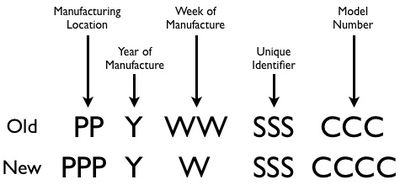
Apple's 11-character serial number system has utilized an alphanumeric format of PPYWWSSSCCC, comprising two digits "PP" denoting a plant code where the product was produced, a single digit "Y" denoting the year of manufacturing, two digits "WW" signifying the week of the year in which the machine was produced, a three-digit unique identifier "SSS" to distinguish between machines that would otherwise have the same serial numbers, and a final three digits "CCC" specifying the model.
The new 12-digit serial number format makes a few minor tweaks to the format, which we have been able to decipher. The increase in length for the new format, which takes on the sequence PPPYWSSSCCCC, can be attributed to changes to the length of the "P", "W", and "C" portions of the code.
The addition of a third "P" digit to assist in identifying the manufacturing location is a fairly straightforward change, although it remains to be seen whether existing plant codes will simply have a character such as a "0" appended to them or if the system is being entirely reworked. The difference in the "W" component is more significant, however, including a shift to alphanumeric codes that will make it a bit more difficult to decipher a machine's manufacturing at a simple glance. The "W" change is also related to a difference in how the "Y" component is used.
Under the previous format, the "Y" component of the serial number was simply the last digit of the year of manufacture, meaning that a machine produced this year would carry a "0" in that position. The number in that position would obviously recycle every ten years, but it should be relatively clear from Apple's product release history whether a given machine was produced in 2000 or 2010.
While leaving the length the same at one character, Apple has modified the "Y" component to include a letter code instead of a number, and the new system will reflect in that code not only the year of manufacture, but also whether it was manufactured in the first or second half of the year. Apple has elected to use 20 different letters in this position, omitting vowels A, E, I, O, and U, as well as B. As with the previous system, letters in this position will recycle every ten years. For 2010, machines with a "C" in this position will have been manufactured in weeks 1-26, while machines with a "D" will have been manufactured in weeks 27-52 or 53. Next year will see the use of codes "F" and "G", and so on.
With the reduction of the "W" component of the serial number to a single alphanumeric digit, Apple has had to roll out a new system for identifying the week in which a given machine was produced. Previously, the two-digit code simply reflected the week of the year, beginning with "01" and moving on through "52" or "53".
The new format utilizes one of 27 alphanumeric characters to denote the week of manufacture, beginning with 1-9 and moving on to letters, omitting 0, vowels A, E, I, O, and U, as well as B, S, and Z. Because the 27 possible characters can not account for all of the weeks in the year, the "W" component must be paired with the "Y" component to determine whether the machine was manufactured in the first or second half of the year, with the "W" codes recycling every six months.
The three-character alphanumeric "S" code for unique product identification remains the same under the new system, while the alphanumeric "C" code for identifying model numbers has been expanded from three characters to four.
The ability to decipher Apple's serial number code to ascertain when a given machine was produced has been used by many customers wishing to learn more about the age of their machines, particularly when it comes to production issues. Understanding whether production date makes a difference in whether machines do or do not suffer from a given issue can help pinpoint when fixes might have been deployed and either alert or reassure customers attempting to determine whether their machines might be affected.