Apple Music Spatial Audio to Get Dynamic Head Tracking in the Fall - MacRumorsOpen MenuShow RoundupsShow Forums menuVisit ForumsOpen Sidebar
Skip to Content

Apple Music Spatial Audio to Get Dynamic Head Tracking in the Fall

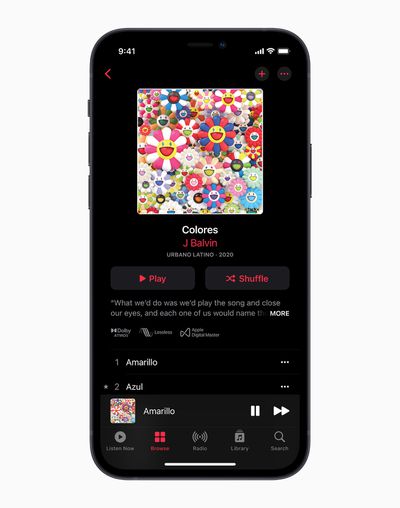
Apple is currently rolling out spatial audio and lossless audio for Apple Music, offering subscribers a more immersive and higher-quality audio experience. Later this year, however, Apple will also bring dynamic head tracking to songs in the Apple Music catalog.
apple music spatial audio
From the FAQ section of a newly updated Apple support document:

Is spatial audio with dynamic head tracking available for music?

We are excited to announce that spatial audio with dynamic head tracking is coming to Apple Music in the fall. Dynamic head tracking creates an even more immersive experience for spatial audio. It brings music to life by delivering sound that dynamically adjusts as you turn your head. And you can experience spatial audio with dynamic head tracking on AirPods Pro and AirPods Max with a compatible iPhone or iPad.

When you consider Apple's current implementation of dynamic head tracking, it's not entirely clear how it will apply to music. In its existing form, dynamic head tracking can be experienced when watching video on iPhone and iPad with headphones that support spatial audio, but it's the video element that's key.

Spatial audio uses the gyroscope and accelerometer in the ‌headphones‌ and the iOS device to track the motion of your head and your ‌device's position, comparing the motion data, and then remapping the sound field so that it stays anchored to your device even as your head moves.

Apple Music videos with spatial audio enabled already support dynamic head tracking in this way, but given that there's no visual element involved when listening to audio tracks, Apple presumably has a different implementation in mind that will create more depth to the listening experience. Individual instruments and effects may remain locked in place in a virtual soundstage when you turn your head, evoking the experience of being in the audience at a live gig, for example.


At any rate, Apple says that Apple Music subscribers will be able to experience it for themselves "in the fall," which is also when iOS 15 will be released to the public, so the two could well drop together.


Popular Stories

apple music

Apple Music to Label AI-Generated Songs

Thursday August 20, 2026 4:41 pm PDT by
Apple sent emails to its music industry partners about the upcoming launch of a Made With AI label that Apple will apply to AI-generated content (via The Hollywood Reporter). Content tagged as being "materially generated using AI" will have a label visible to all Apple Music users. In March, Apple announced Transparency Tags, a system that lets music creators disclose when AI has been...
Apple iCloud Plus expansion hero

iCloud+ Now Includes Apple TV, Apple Arcade, and Curated Apple Music Stations in Over 100 Countries

Tuesday September 15, 2026 1:43 am PDT by
Apple today announced a new subscription initiative that turns paid iCloud+ subscriptions into a broader services bundle in more than 100 countries. In select countries, Apple says every paid iCloud+ plan, including the cheapest 50GB tier, now includes Apple TV and Apple Arcade "at no additional cost," while family sharing extends the storage, TV and Arcade access to up to five people....
iOS 27 Next to iPhone

Here's When iOS 27 Rolls Out Today in Every Time Zone [Update: It's Out]

Sunday September 13, 2026 3:00 am PDT by
Update 10:04 a.m.: iOS 27 is rolling out now, though it may take a bit for all users to see it, so keep checking! Apple is about to release iOS 27, which will finally deliver more advanced Siri AI capabilities as well as a variety of other refinements, improvements, and new features to iPhones. It's Apple's biggest software update of the year, and Apple announced at Wednesday's iPhone event...

Top Rated Comments

69 months ago
It's working already in the iOS15 Beta, as far as I can tell. I move my head and the music sound field stays fixed in the same position. eg. the vocals appear to be anchored to a certain place in the room around me.

Honestly, I think this is a total game changer. It's like stereo on steroids.
Score: 11 Votes (Like | Disagree)
Canubis Avatar
69 months ago
Honestly I thought that’s what yesterday’s launch of spatial audio was all about? instead we just got music in a different audio format, slightly differently mixed? At least to my understanding Spatial Audio was all about interactivity, if I move my head the sound mix would adapt to feel as if I am directly in the sound scene, adding an extra level of immersion.
But in reality it’s still output just like stereo material, just with a fixed fake sound stage…? Maybe I am over critical but what’s the point?
Plus fun fact: the promo videos for Spatial Audio in Apple Music actually Support The head tracking.
Super confusing marketing/rollout for this product…
Score: 5 Votes (Like | Disagree)
69 months ago

It's working already in the iOS15 Beta, as far as I can tell. I move my head and the music sound field stays fixed in the same position. eg. the vocals appear to be anchored to a certain place in the room around me.

Honestly, I think this is a total game changer. It's like stereo on steroids.
The haters can hate but Spatial Audio is in a class of its own. There's a few tracks where it's abysmal but that comes down to the engineer. Other tracks, like many of Ariana Grande's, a few of the Weeknd's and especially that Marvin Gaye remaster are masterpieces.
Score: 5 Votes (Like | Disagree)
69 months ago

Except you're just listening through Stereo headphones, so all you're hearing is a different mix...in stereo.

In fact i'm pretty sure I could just recreate the sound of the spatial audio in stereo - it can't do anything but pan it left and right when mixes down to stereo anyway.
Dude, HRTF aka A head-related transfer function, is a response that characterizes how an ear receives a sound from a point in space. As sound strikes the listener, the size and shape of the head, ears, ear canal, density of the head, size and shape of nasal and oral cavities, all transform the sound and affect how it is perceived, boosting some frequencies and attenuating others.

You do understand you have only two holes in your head but with those two holes and the magic of our own sound processing we know where the sound is coming from. The different sound directions can be simulated with normal headphones. However, in order to make this convincing this needs heavy sound manipulation. With enough processing power and 100% isolation you can make headphones virtual surround as good as the real thing.
Score: 3 Votes (Like | Disagree)
69 months ago

I'd think you do want head tracking when your phone's in your pocket, but it should be tracked relative to your phone. So you walk along looking forward and the sound stays the same (even if you go round a corner), but look to your side and it changes.
I didn’t explain well :P

What I mean is it won‘t use the phone to place where your head is at, it will use the AirPods - so when your head tilts you do hear instruments in different locations (but in same place) - so the headphones and phone will create a virtual space and place those instruments… I can’t explain lol
Score: 3 Votes (Like | Disagree)
Kier-XF Avatar
69 months ago

As for the full 360 thing I still disagree. It just doesn't trick my ears like it apparently does yours and a few other peoples - my brain distinctively just hears the sound swap from the left to the right speaker like it's hard panned with a touch of out of phase stereo widening.
That's what I was referring to with the comment about having an unusually shaped head. Your brain is wired to place sound based on the way it travels around your head, so if your head is quite differently-shaped from the model used to render Dolby Atmos into binaural audio by Apple Music, you won't hear the full three dimensions. Most people's heads are sufficiently similar to the model to get a close approximation.

On the other hand, if you were to get your head shape scanned and the data plugged into a Dolby Atmos renderer, you absolutely would hear sounds above, below and behind you - that's just how hearing works.
Score: 2 Votes (Like | Disagree)

🔗 Related Apple News & Rumors

Stay updated with the latest Apple ecosystem news and verified rumors